
French mortgage rates have fallen considerably from their peak in early 2024, but borrowing costs remain significantly higher than they were before the interest-rate crisis of 2022–2023. According to the Banque de France, the average interest rate on new French housing loans was approximately 3.32% in August 2026 (compared with 4.17% in January 2024).
For people considering buying property in France in 2027, the outlook remains uncertain. Although mortgage lending has begun to recover, the French property market continues to face challenges from higher borrowing costs, restrictive lending regulations, political uncertainty and concerns over France's public finances. These difficulties have been particularly noticeable among younger French buyers, many of whom have struggled to obtain mortgages despite having stable employment.
For international buyers, however, French mortgages still have some attractive features, particularly the availability of long-term fixed interest rates.
In this article, we examine current French mortgage rates, the outlook for 2027, the state of the French property market and how foreign buyers can obtain a mortgage in France.
French mortgage rates: historical trends 2020–2026
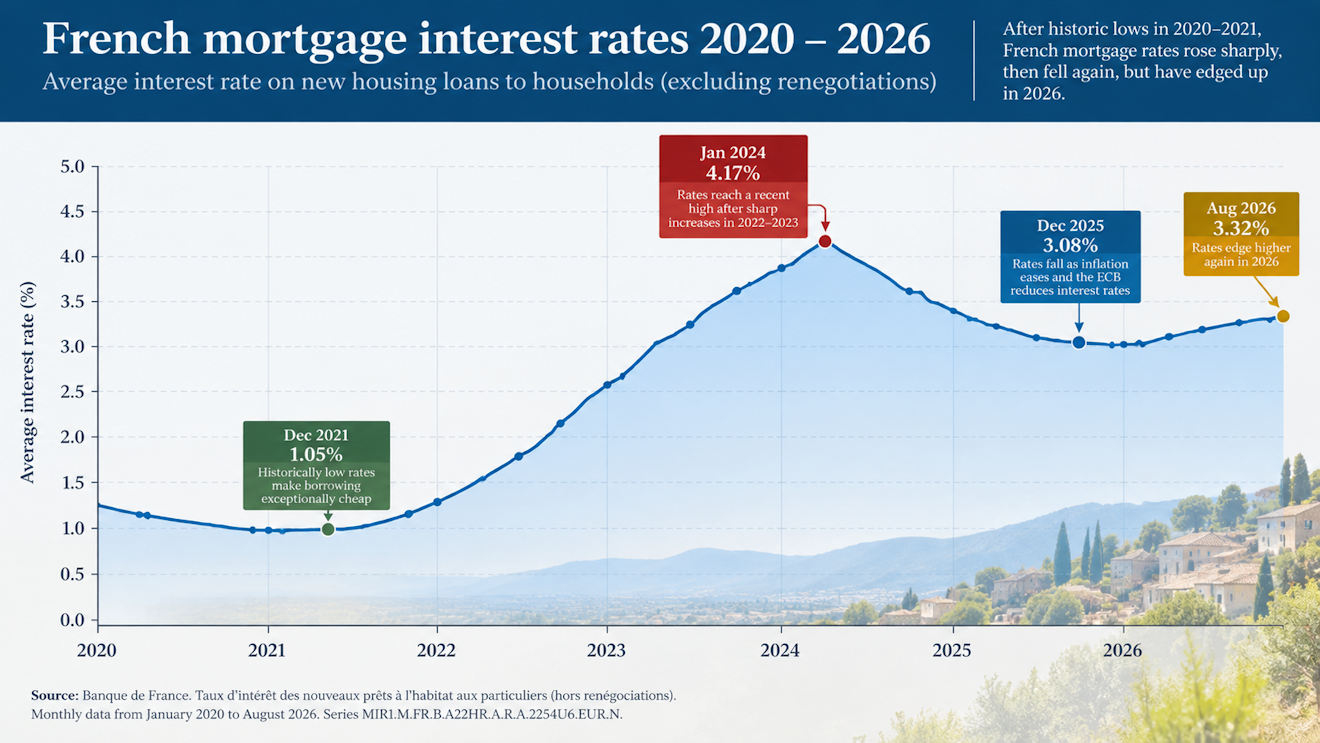
Between 2020 and early 2022, French mortgage rates remained at historically low levels, falling to around 1% by the end of 2021. This made borrowing exceptionally cheap and helped fuel a buoyant French property market.
However, mortgage rates rose sharply during 2022 and 2023, driven by a combination of factors:
- The Covid-19 pandemic: causing disruption to global supply chains, followed by a surge in consumer demand as economies reopened.
- Russia's invasion of Ukraine: leading to soaring gas, electricity and food prices, which pushed European inflation significantly higher.
- European Central Bank policy: precipitated a series of interest-rate increases designed to bring inflation under control.
- Rising bank financing costs: higher bond yields and wholesale borrowing costs, which were passed on to mortgage customers.
By early 2024, average French mortgage rates had climbed above 4%. This dramatic increase, combined with tighter mortgage lending restrictions, contributed to a sharp downturn in the French property market.
Mortgage rates subsequently declined during the rest of 2024 and into 2025 as inflation eased and the European Central Bank began reducing interest rates. By the end of 2025, average French mortgage rates had fallen to approximately 3.1%.
However, the outlook changed again during 2026. Rates began edging upwards, and several French mortgage specialists are forecasting further modest increases during the final quarter of 2026 and into 2027.
The main concerns are:
- French government debt and political uncertainty which have put pressure on French government bond yields.
- Continuing geopolitical tensions particularly the wars in Ukraine and the Middle East, and their potential impact on energy prices.
- Inflation risks which could limit the European Central Bank's ability to reduce interest rates further.
- Higher long-term financing costs making it more expensive for French banks to provide fixed-rate mortgages.
According to forecasts published by French mortgage broker Meilleurtaux in February 2026, average mortgage rates could reach approximately 3.6% during 2027, potentially rising to 3.95% by December 2027. More recent forecasts from CAFPI have also warned of upward pressure on mortgage rates.
Although these are forecasts rather than confirmed future rates, they suggest that buyers should not expect a return to the exceptionally cheap mortgages available before 2022.
Sources: Banque de France, Meilleurtaux and CAFPI.
Impact on the French property market
The combination of rising mortgage rates and tighter lending restrictions had a dramatic impact on the French property market. As borrowing became more expensive and mortgage approvals more difficult to obtain, property sales fell sharply and house prices came under pressure.
In January 2022, the French authorities made new mortgage lending restrictions legally binding. Banks were generally limited to mortgages of 25 years, with total monthly loan repayments, including mortgage insurance and existing debts, restricted to 35% of a borrower's income. These rules left many prospective buyers with less borrowing capacity, just as mortgage interest rates were beginning to rise.
According to the Notaires de France, the French body which represents property lawyers in France, annual property sales in France fell from around 1.12 million in 2022 to 869,000 in 2023, a decline of approximately 22%. The downturn continued during 2024, before the market began to recover in 2025.
The collapse in mortgage lending was even more dramatic. Figures from the Banque de France show that the total value of new housing loans fell by 41% in 2023, followed by a further 14% decline in 2024.
Although lending recovered by 33% in 2025, reaching €146.7 billion, this was from an exceptionally low base. Property sales also recovered, but activity remained below the levels recorded before the downturn.
The recovery has continued to be uneven during 2026. By August, the Banque de France reported that new mortgage lending was running at approximately €12.2 billion per month, while the average mortgage interest rate had edged upwards to 3.32%.
The French authorities have argued that tighter lending rules were necessary to protect households from excessive debt. However, I believe that imposing such rigid restrictions just as interest rates were rising significantly worsened the difficulties facing the property market.
Sources: Notaires de France; Banque de France / ACPR, March and October 2026.
Impact on the ground in France
The figures illustrate the scale of the downturn in the French Property market over the last 2 years. But they don't tell the full picture. The consequences have been felt not only by estate agents, mortgage brokers and property sellers, but also by younger buyers trying to purchase their first home.
According to FNAIM, the French national federation of estate agents, 1,237 estate agencies went bankrupt during 2024, an increase of 52% compared with the previous year. In its June 2025 report, FNAIM estimated that approximately 3,000 property-sector businesses and 15,000 salaried jobs had disappeared over the preceding two years.
Source: FNAIM, January and June 2025.
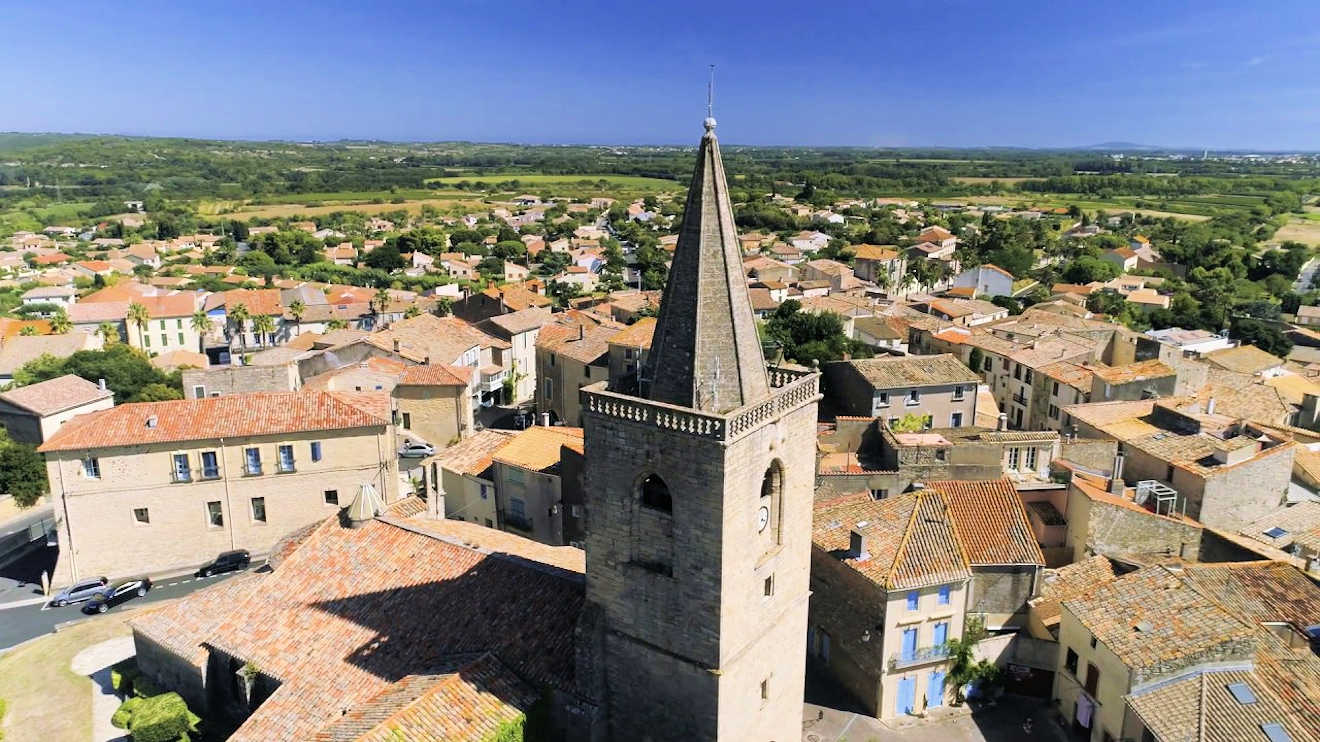
We live in a tiny French village in South France, far away from Paris, the Government and the interest rate setters. My eldest son is now 28 years old. One of his best friends has a permanent job working for the local government in France, which he has worked in since he left school. He has a secure income and the sort of employment stability that French banks traditionally value. Yet when he applied for a mortgage, the bank told him that his existing car loan was a problem. To qualify for the mortgage, he would need to sell his car and repay the outstanding loan. Now, in rural France, where a car is often essential for getting to work, that is hardly a practical solution.
In my son's circle of around 10-15 friends aged from 25-30 years old, only one person owns their own home. The French banks maintain that the tighter lending restrictions they imposed from 2022 onwards, were necessary to prevent excessive household borrowing. That is a reasonable objective. But there must surely be a balance between protecting people from taking on too much debt and allowing young adults to purchase their first home. If young people (from the village) cannot afford to buy a house in the village, then the village dies. Pure and simple.
How the French mortgage lending market works
The structure of the French mortgage market has helped protect existing homeowners from the impact of rising interest rates. Unlike the UK, where borrowers often fix their mortgage rate for just 2–5 years, French banks typically offer fixed-rate mortgages for the entire loan term. According to the Banque de France, 99.5% of new French housing loans were fixed-rate mortgages in August 2026.
This has provided considerable stability during periods of economic uncertainty, including the Covid-19 pandemic and the energy crisis following the war in Ukraine. Homeowners with existing fixed-rate mortgages were largely protected from the sharp increases in borrowing costs during 2022–2024. However, first-time buyers and people moving house faced significantly higher mortgage rates and tighter lending conditions.
France also has one of Europe's largest mortgage markets. According to the Banque de France, outstanding residential mortgage lending reached approximately €1.29 trillion in August 2026. Although the mortgage market expanded substantially during the previous two decades, growth has slowed considerably since 2022, reflecting the downturn in property transactions and new lending.
Source: Banque de France, August 2026.
French mortgage interest rate forecasts for 2027

French mortgage brokers are increasingly cautious about the outlook for interest rates in 2027. Rather than predicting a return to the exceptionally cheap mortgages available before 2022, several analysts now expect borrowing costs to remain elevated.
More recent assessments have become increasingly cautious. In October 2026, French mortgage broker CAFPI predicted that average mortgage rates could reach 3.70–4.00% by the end of 2026, citing inflation, higher government bond yields and rising financing costs.
Meilleurtaux has also warned that mortgage rates are moving towards 4%, with continued geopolitical uncertainty and concerns over government borrowing contributing to upward pressure.
These forecasts are not guarantees, and different analysts use different assumptions and mortgage measures. Nevertheless, they suggest that buyers planning a property purchase in France during 2027 should not automatically expect mortgage rates to fall.
For international buyers, the practical implication is to establish what they can comfortably afford at current interest rates, while allowing for the possibility that borrowing could become more expensive.
How to get a French Mortgage in 2027

If you are planning to buy a house in France in 2027, arranging a French mortgage may be easier than you think, although the application process can be more complicated for foreign buyers. French banks offer both fixed-rate and variable-rate mortgages, but fixed-rate repayment mortgages are by far the most common. These allow you to fix your interest rate for the entire mortgage term, giving you certainty over your monthly repayments.
Foreign buyers can apply for mortgages from French banks, whether they intend to live permanently in France or purchase a second home. However, the amount you can borrow will depend on your income, existing debts, employment status, deposit and whether you are resident in France.
French banks generally expect buyers to contribute a substantial deposit. For non-residents, this may be around 20–30% of the purchase price, although some lenders require more. You will also need sufficient funds to cover the notaire's fees and other purchasing costs.
As discussed earlier, French mortgage lending is subject to two important restrictions:
- 35% debt-to-income limit: Your total monthly loan repayments, including existing borrowing and mortgage insurance, should generally not exceed 35% of your net income before income tax.
- 25-year mortgage limit: Most French mortgages are limited to 25 years, although certain qualifying purchases involving construction or substantial renovation work can allow up to 27 years.
Banks have limited flexibility to approve applications outside these rules, but there is no guarantee that an applicant will qualify. For overseas buyers, it is worth speaking to a French mortgage broker before committing to a purchase, particularly if your income is earned in another currency.
Three ways to finance a property purchase in France
If you are buying a second home or moving to France from abroad, there are three main ways to finance the purchase.
1. Raising a mortgage against your existing home
If you own a property in the UK, Ireland or another country, you may be able to release some of the equity to help finance your French property purchase. This could involve re-mortgaging your existing home or arranging additional borrowing with your current lender. The advantage is that you are dealing with a familiar banking system, potentially avoiding the need for a French mortgage.
However, borrowing against your principal residence increases the debt secured on that property. You should also consider exchange-rate movements if you borrow in one currency and purchase in euros.
2. Taking out a mortgage on your French property
The second option is to obtain a mortgage from a French bank, secured against the property you are buying. This is a popular choice for foreign buyers because it allows them to finance their purchase without necessarily increasing the mortgage on their existing home. French banks typically offer repayment mortgages with fixed interest rates over 15, 20 or 25 years. Variable-rate mortgages are also available, although they are much less common.
The main disadvantages are the documentation required, the deposit requirements and the time needed for approval. Non-resident applicants may also find that fewer banks are willing to consider their application.
3. Hybrid mortgages
A third option is to combine borrowing against your existing home with a French mortgage. For example, you could release equity from your current property to cover the deposit and purchasing costs, then arrange a French mortgage for the remaining balance.
This can be attractive if you have substantial equity in your existing home but prefer not to use all your savings to finance the purchase. However, you would be responsible for two loans, potentially in different currencies, and both sets of repayments would need to be considered when assessing affordability.
Paddy Gibbins the Managing Director of Artaxa Immo, a French real estate business that specialises in helping Foreign investors buy French property, states that he has seen a growing trend in hybrid mortgages in France, whereby investors raise money against their principal home and the French property. This is proving especially popular with purchasers who do not have a large savings pot to pay the deposit or clients who want to keep their savings intact. Paddy explains that the general process is that:
"basically, the deposit and purchasing costs are raised on the principal home of the purchaser and the equity for the loan is raised against the French property".
Are interest-only mortgages available in France?
Interest-only mortgages (prêts in fine) are available from some French lenders, although they are much less common than standard repayment mortgages. With an interest-only loan, borrowers pay interest during the mortgage term and repay the capital at the end. These products are generally aimed at borrowers with substantial savings or other assets, and banks may require additional financial security. They are not normally the most straightforward option for foreign buyers purchasing a home in France.
French mortgage applications: documents required

French banks tend to be thorough when assessing mortgage applications. Foreign buyers should expect to provide detailed information about their income, savings, existing debts and financial circumstances.
The documents commonly requested include:
- Valid passport or identity card.
- Proof of your current residential address.
- Last three months' bank statements.
- Last three payslips and evidence of employment.
- Employment contract or proof of pension income.
- Recent income tax returns, usually covering the previous one or two years.
- Details of existing mortgages, personal loans and other borrowing.
- Evidence of savings and the funds available for your deposit.
- Details of the French property, including the signed preliminary purchase contract when available.
- For self-employed applicants, business accounts and additional evidence of income.
- Depending on your circumstances, the bank may also request marriage certificates, details of other properties you own or translations of financial documents.
Once your application has been assessed, the bank may issue an agreement in principle. This is not the same as a formal mortgage offer.
The full application process can take several weeks, particularly for non-residents. Under French law, borrowers must also observe a 10-day reflection period after receiving their formal mortgage offer before they can accept it.
It is therefore important to allow sufficient time for mortgage approval when agreeing the completion date for a property purchase.
How much can you borrow in France?
The amount a French bank will lend depends on your income, existing financial commitments, deposit and the value of the property. The key restriction is the 35% debt-to-income rule, which includes the proposed mortgage repayments, borrower insurance and repayments on existing loans.
For example, someone earning €4,000 per month in qualifying net income would generally have a maximum monthly debt repayment allowance of €1,400. If they already have a car loan costing €300 per month, that leaves approximately €1,100 for their mortgage repayments and insurance.
This is one reason why existing car loans and other personal borrowing can have such a significant effect on French mortgage applications.
French mortgage repayment examples
The following examples show the approximate monthly repayments on a €200,000 repayment mortgage, excluding insurance and fees.
| Interest rate | 20-year mortgage | 25-year mortgage |
|---|---|---|
| 3.0% | €1,109 | €948 |
| 3.5% | €1,160 | €1,001 |
| 4.0% | €1,212 | €1,056 |
These are illustrative calculations rather than current mortgage offers. Your actual borrowing costs will depend on the bank, loan term, insurance and your personal circumstances.
French mortgage fees and charges
When arranging a mortgage in France, there are several additional costs to consider beyond the interest rate.
- Bank arrangement fees: French banks may charge an administration or application fee (frais de dossier). The amount varies between lenders and may be negotiable.
- Mortgage security costs: Banks generally require security for the loan. This might take the form of a mortgage registered against the property or a guarantee provided by a specialist organisation. The cost depends on the type of security and the amount borrowed.
- Mortgage broker fees: If you use a mortgage broker, there may be an additional fee for arranging the loan. Always establish the cost and when it becomes payable before proceeding.
- Borrower insurance: French banks normally require insurance covering risks such as death or disability. The cost depends on your age, health, loan amount and the cover required. Borrowers can generally choose an alternative insurer providing equivalent cover.
- Early repayment charges: Some French mortgages allow you to repay the loan early without penalties, but others include early repayment compensation. Where applicable, this is normally capped by French law at the lower of six months' interest on the amount repaid or 3% of the outstanding capital before repayment.
When comparing French mortgage offers, look at the TAEG (taux annuel effectif global), which expresses the overall annual cost of borrowing, including specified fees and insurance costs, rather than just the advertised interest rate.
Buying a house in France: should you rent first?

For many foreign buyers, purchasing a house in France is a major financial and lifestyle decision. Choosing the right region, finding a suitable property and arranging mortgage finance can all take longer than expected.
One option worth considering is to rent a property in France for several months before buying.
A long-term rental gives you time to explore different towns and villages, understand local property prices and experience everyday life in France before committing to a purchase. It can also provide a useful base while you search for a property, arrange mortgage finance and work through the French buying process.
At Long Term Rentals in France, we specialise in furnished rentals for periods of approximately 2–12 months. Many of our clients use these properties as a temporary home while looking for somewhere to buy or planning a permanent move to France.
You can explore our long term rentals in France and find accommodation while you decide where you would like to settle.
Thinking of moving to France?
 Paddy Gibbins is the Managing Director of Artaxa RE/MAX, a French real estate business that specialises in helping Foreign investors buy French property. The agency is based in the beautiful wine village of Roujan and provides a property sales teams across the Languedoc region. Artaxa is a genuinely International real estate firm, employing multi-lingual staff in the three regional offices.
For further information about buying property in South France, please contact Jane Laverock on +33 6 95 50 19 21 or by email at Jane@artaxaimmo. Alternatively, if you have any particular questions you would like to ask about living in the South of France, then contact Iain by Email.