
The French property market has experienced a difficult few years. Following the boom in house sales during 2020–2022, the last 3-4 years have seen the market suffer from rising mortgage rates, falling demand and increasingly restrictive lending conditions. But there are signs that the situation is changing. House sales have recovered from their recent lows, mortgage lending has improved and buyers have had time to adjust to higher borrowing costs.
Our prediction for the French property market in 2027 is cautiously optimistic. We expect more properties to change hands, although we do not anticipate another property boom or a dramatic increase in house prices. After several years of postponing decisions, homeowners may simply be ready to move again.
How healthy is the French property market in 2027?
So how do you measure whether a country's property market is heathy or not? Rising house prices do not necessarily mean that a property market is bouyant. During the recent downturn, many French homeowners continued to advertise their properties at high prices, even though fewer buyers were able or willing to purchase them.
To understand whether the French housing market is recovering, we need to consider six important indicators: house prices, property sales, mortgage rates, mortgage lending, housing affordability and housing supply.
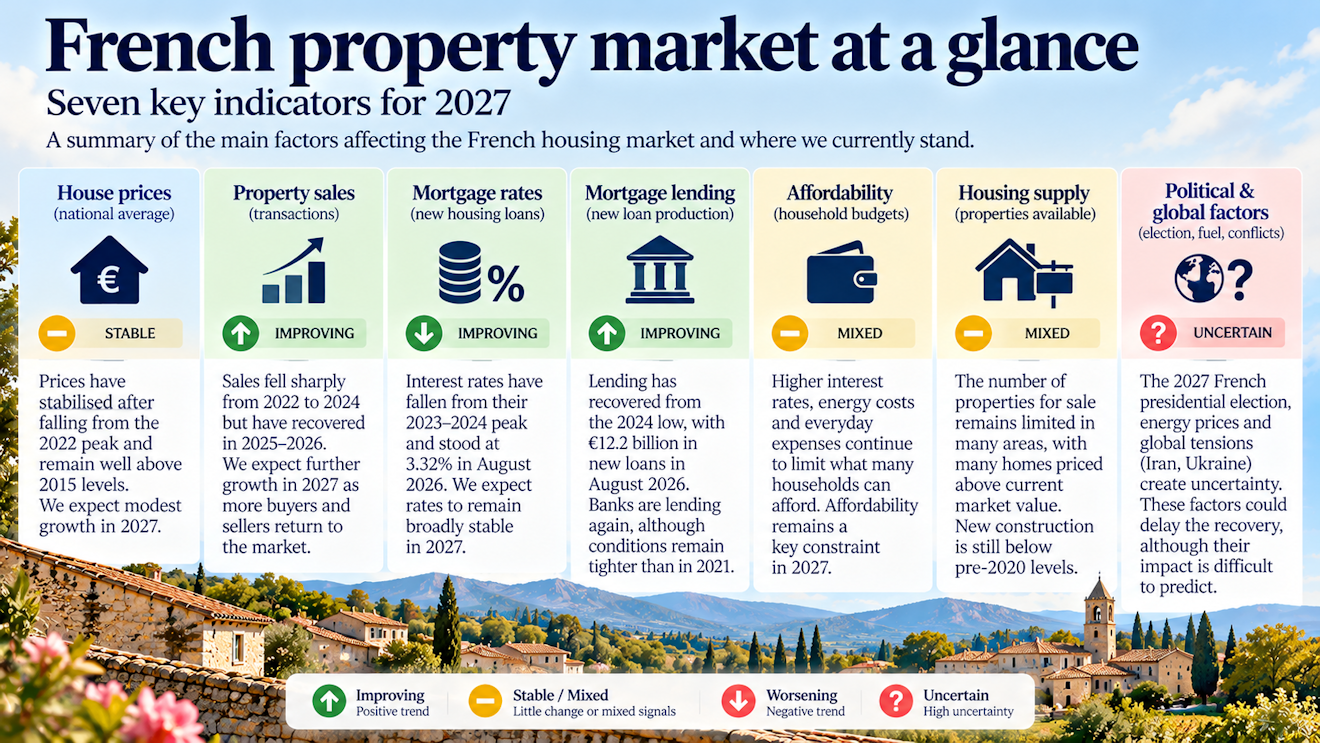
There is also a seventh factor that could influence the market during 2027: political and international uncertainty, including the French presidential election and the effect of conflicts on energy prices.
A healthy property market is not necessarily one where prices keep increasing. It is one where buyers can obtain finance, sellers can find purchasers and houses change hands at prices people can afford.
1. French house prices in 2026: has the market reached the bottom?
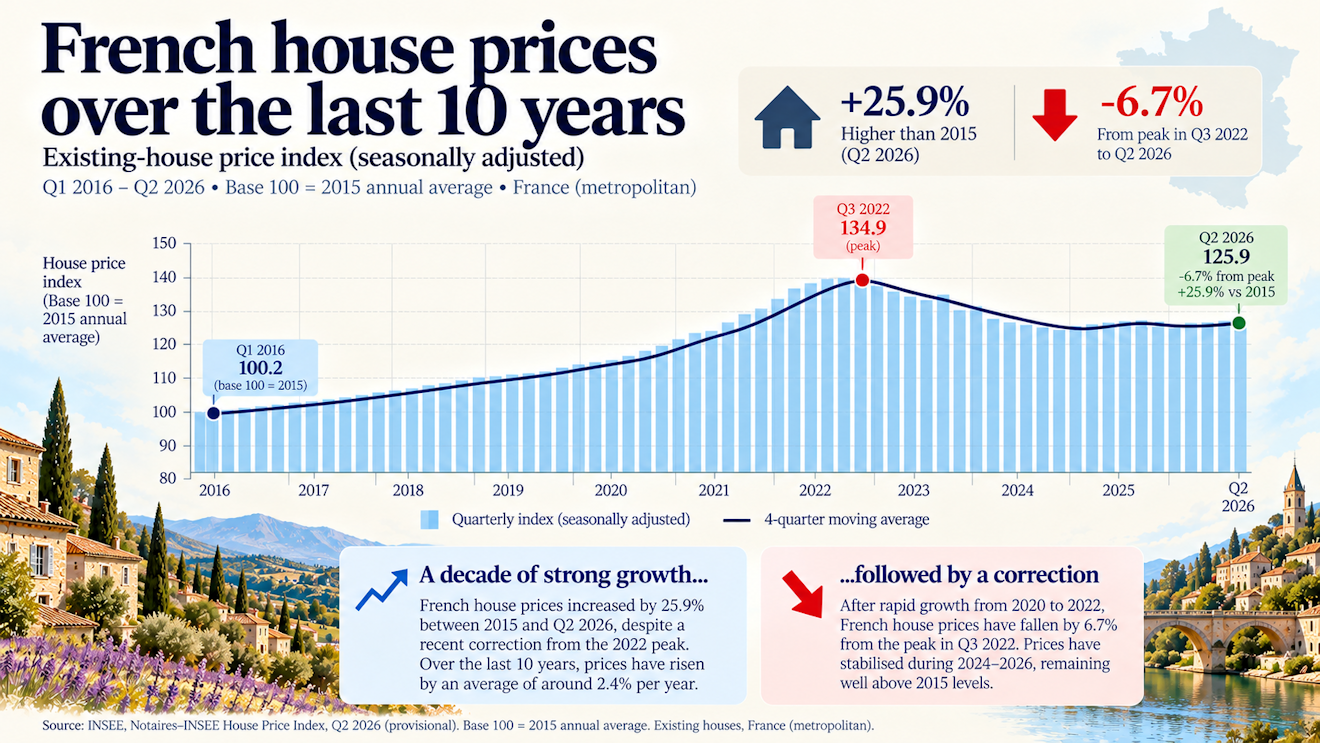
French house prices rose considerably between 2016 and 2022, supported by historically low mortgage rates and strong demand. However, the rapid increase in borrowing costs and tightening lending conditions, brought this period of growth to an abrupt end.
By 2026, national property prices had fallen from their 2022 peak, although they remained substantially higher than a decade earlier (up by 25% overall). The adjustment has also varied considerably between different parts of France.
In 2027, we believe house prices are more likely to remain broadly stable or rise only modestly.
For a detailed breakdown of prices across France, see our guide to house prices in France.
Why are so many houses in France overpriced?
 One reason why the French property market can be slower to recover than other countries, is the gap between what French homeowners believe their properties are worth and what buyers are prepared to pay. From our experience of the property market in Southern France, there doesn't seem to be much 'science' to how properties are valued. My wife works as a real Estate agent here, so I get to hear first hand how properties often come to be valued. More often than not, the homeowner themselves, establish their asking price, and the Real estate agents just go along with the valuations in order to get the Owner's mandate to sell the house.
Often the homeowner will calculate what they need to buy their next property. If they need €350,000 to move, that can become the asking price for their existing house, even when comparable properties are selling for €300,000.
Similarly, sellers frequently compare their property with other local houses advertised for sale. If a similar house in the same village is advertised for €375,000, they naturally assume their own property must be worth something similar. But that neighbouring property may have been on the market for two or three years without attracting a serious offer.
The final complication in France is that French homeowners are quite content for their house to sit on the market for 2-3 years. My wife recently visited a homeowner (who actually was a Real Estate agent herself!) and she said that the house had been on the market for 18 months and she had only had one visit in all that time. The Owner went through all the different variables - quality of the photos, the selling agents, the war in Ukraine - before my wife brought the conversation round to the asking price.
Inherited properties and unrealistic asking prices
Another situation we regularly encounter in France concerns inherited properties. When a house is left to three or four siblings, the asking price can sometimes be influenced by how much each beneficiary hopes to receive from the sale, together with any inheritance tax and estate-related costs they may need to pay.
For example, if four siblings each hope to receive €100,000 after settling their obligations, they may want to advertise the property for considerably more than €400,000, even though comparable houses are selling for much less.
The situation can become more complicated when the heirs disagree about the asking price or whether to accept a lower offer.
How should houses in France be valued?
 My wife works as an estate agent in Southern France. Her agency uses professional valuation software drawing on completed property transactions recorded by the French notaires. The software examines recent sales in the same commune, generally over the previous three to six months, to calculate an average selling price per square metre.
This provides a starting valuation, which can then be adjusted to reflect the condition of the property. Her agency's system generally allows an adjustment of around 5% above or below the calculated value.
Of course, no two houses are identical. In smaller villages there may be too few recent transactions to establish a reliable average. Location, outside space, parking, renovation requirements and other characteristics can all make a substantial difference.
Nevertheless, recent completed sales provide a much more reliable starting point for valuations, than the advertised prices of houses that have not sold. It is for this reason that the boss of the agency, Paddy Gibbins, always remarks that they have an above average probability that they will sell a house, when they are the second or third agent to take on the Mandate. The reason is clear: they provide a more realistic sales price.
Could more realistic asking prices help the market recover?
We believe they could.
Many homeowners in France have postponed moving over the last few years. Some are reluctant to accept lower valuations, while others have simply decided to wait for better conditions.
But people cannot postpone moving indefinitely. Families grow, children leave home, people retire, couples separate and workers relocate. As more sellers accept realistic valuations, properties that have remained unsold may finally begin to change hands.
This is one of the main reasons why we believe house sales could increase during 2027 without a corresponding surge in property prices.
2. French property sales: are buyers and sellers returning?
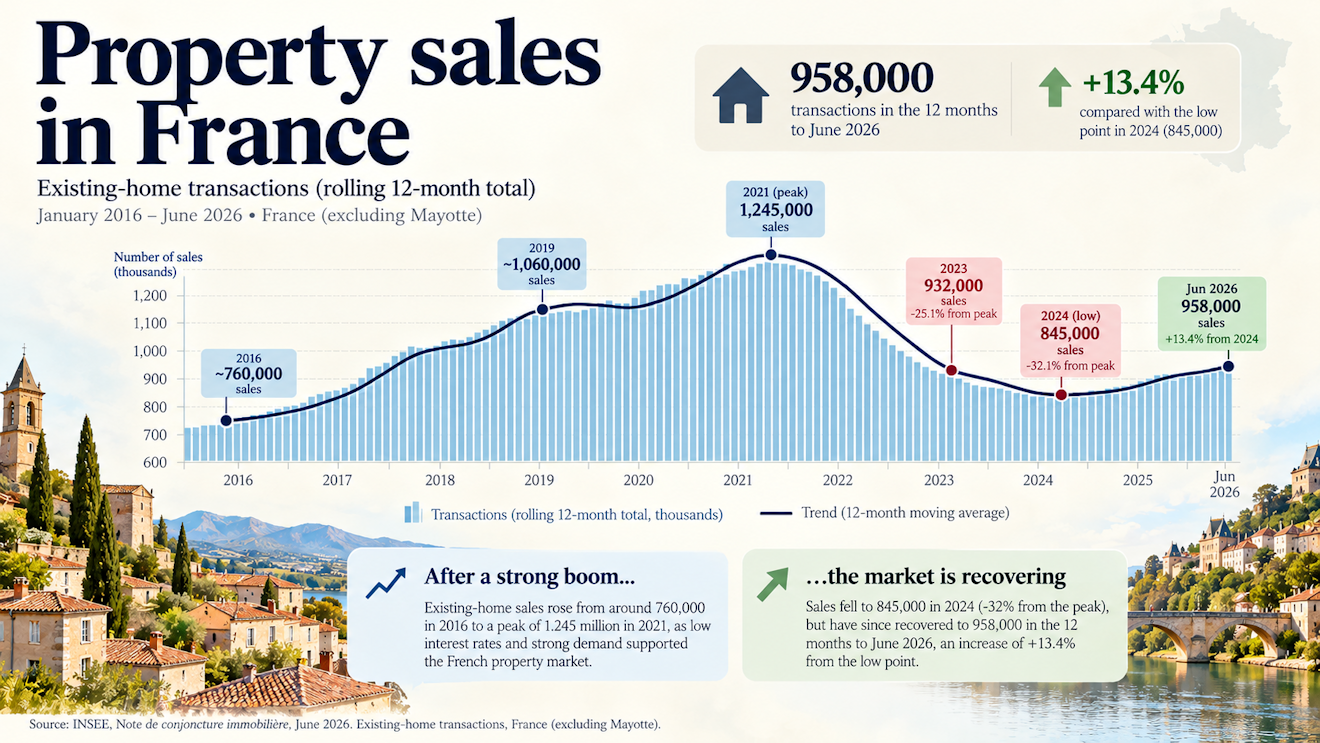
The number of completed property transactions provides one of the clearest indications of the health of the French housing market. Following the exceptional levels of activity in 2021, when annual sales exceeded 1.2 million transactions, the market experienced a substantial decline. By 2024, annual sales had fallen to around 845,000.
The subsequent recovery brought transactions back towards 960,000 in the 12 months to June 2026. This is encouraging, but the market is still operating below its previous peak.
In our opinion, the most important development during 2027 may not be a rise in house prices, but an increase in the number of completed property sales.
3. French mortgage rates: how the banks helped bring the housing market to a standstill
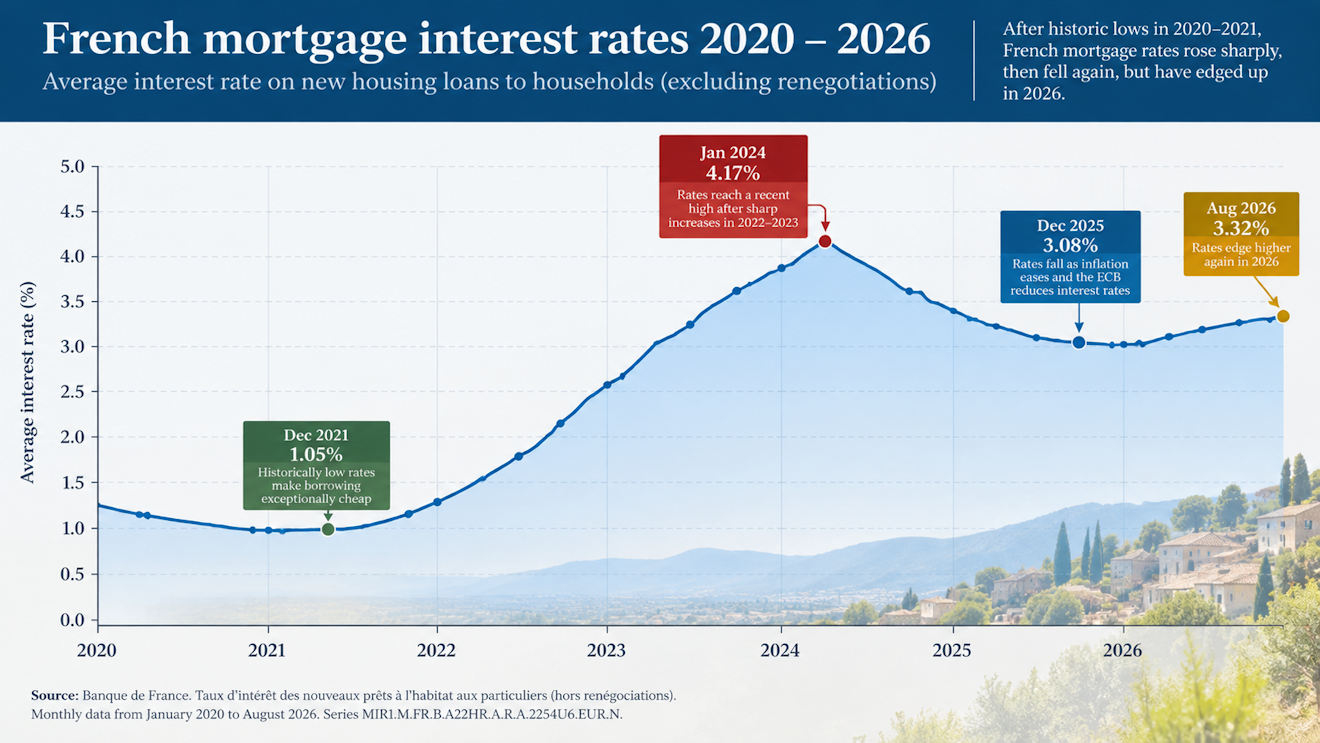
Mortgage interest rates were one of the principal causes of the downturn in the French property market during 2023 and 2024. At the end of 2021, new housing loans were available at historically low rates of around 1%. By early 2024, average rates had climbed above 4%, significantly increasing the monthly cost of buying a property.
Borrowing costs have subsequently eased, with the average interest rate on new French housing loans standing at approximately 3.32% in August 2026.
But rising interest rates were not the only reason why house sales collapsed during 2023 and 2024. In our opinion, the tightening of mortgage lending rules made a difficult situation considerably worse.
How French mortgage restrictions damaged the housing market
Under rules introduced by France's Haut Conseil de Stabilité Financière (HCSF), mortgage repayments, including borrower insurance, were generally restricted to 35% of household income, while mortgage terms were normally limited to 25 years. The intention was to protect borrowers from excessive debt. But the timing could hardly have been worse.
As mortgage interest rates rose from around 1% to over 4%, buyers were already struggling with significantly higher monthly repayments. The borrowing restrictions made it even harder to finance a property purchase. French banks also became increasingly cautious about approving loans. Even buyers with regular incomes, existing assets or substantial deposits could find themselves struggling to obtain financing.
We saw examples of this within our own family and through our experience of the French property market. People who would previously have been considered 'solid' borrowers suddenly found themselves unable to secure a mortgage.
The result was devastating for housing-market activity. Buyers disappeared, property transactions fell sharply and estate agents were left trying to sell houses to a much smaller pool of potential purchasers. According to figures published by FNAIM and Altares, more than 2,200 French estate agencies entered insolvency proceedings during 2024 and 2025, affecting 15,000 employees.
Although banks were permitted some flexibility under the HCSF rules, we believe the combination of restrictive borrowing limits, rapidly rising interest rates and conservative lending decisions unnecessarily deepened the downturn.
4. Are French banks lending again?
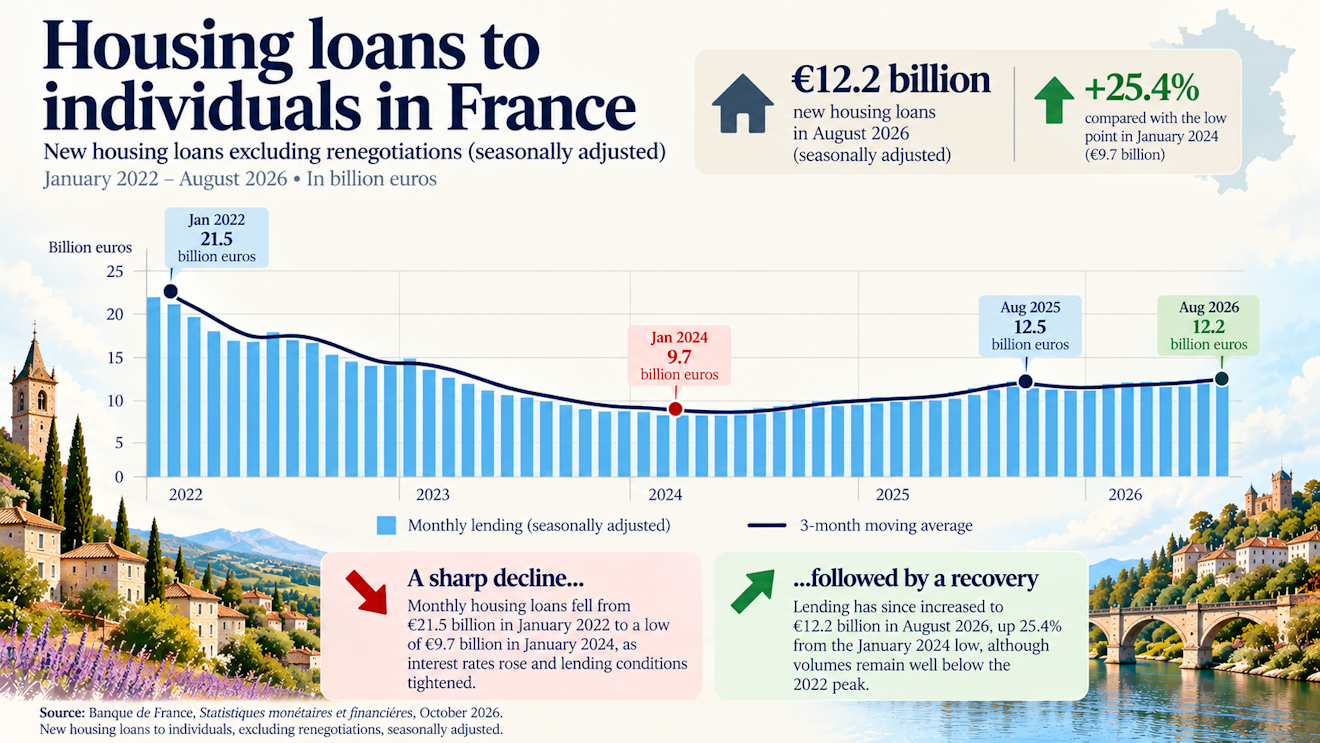
New housing loans fell sharply during 2023 and early 2024, reflecting the combined effects of higher interest rates, weaker demand and tighter affordability constraints. Lending has subsequently recovered, although it remains below the exceptional levels recorded before the downturn.
This is encouraging, but if France wants a properly functioning housing market in 2027, banks need to be willing to lend to French borrowers.
For the latest rates, repayment examples and advice for foreign buyers, see our French mortgage rates guide.
5. Housing affordability
Although mortgage rates have fallen from their recent peak, monthly repayments remain considerably higher than they were when interest rates were close to 1%. Buyers also need to consider property taxes, insurance, energy bills, maintenance and the cost of renovating older French houses.
This is particularly important for first-time buyers, who may have limited savings and no existing property to sell.
Housing affordability also varies enormously across France. A household budget that might buy a substantial family home in Limoges or rural Dordogne, but may only stretch to a small apartment in Bordeaux, Montpellier or parts of the Côte d'Azur.
This is why national house-price averages can be misleading. Not only do property prices differ substantially between regions, but some local markets are recovering much more quickly than others.
Regional differences in French house prices
There is no single French property market, and the differences between regions can be substantial.
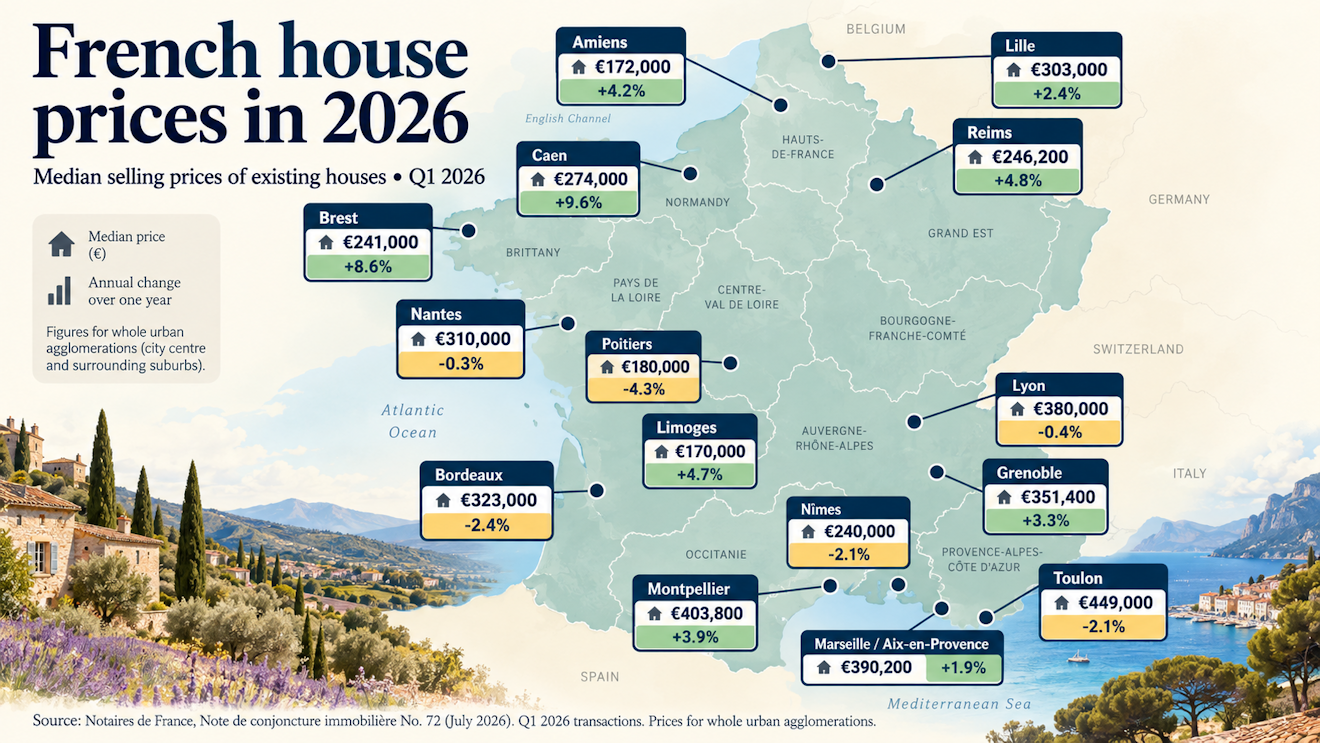
Source: Notaires de France, Note de conjoncture immobilière No. 72, July 2026. Q1 2026 transactions.
According to the Notaires de France, median house prices in the North of France have continued to increase during 2026. Prices in the Caen urban area increased by 9.6% over the year, while prices in Brest rose by 8.6%. Elsewhere, the picture is at best patchy. There are pockets of places where house prices continue to rise (like Limoges and Aix-en-Provence), but elsewhere prices have fallen back
By contrast, Bordeaux, which for many years was one of the most expensive major provincial cities in France, recorded a 2.4% decline in median house prices. Nantes also experienced a slight fall of 0.3%.
Even within Southern France, the picture was mixed. Montpellier recorded an increase of 3.9% (reflecting the fact that it remains the fastest growing city in France), while prices in nearby Nîmes fell by 2.1%.
We expect these regional differences to continue during 2027, with some locations recovering more quickly than others.
6. Housing supply
 The number of properties advertised for sale does not necessarily reflect the number of houses available at realistic prices. In some areas, buyers may have plenty of listings to choose from but very few properties that are reasonably priced, in good condition and suitable for their needs. There are signs that more French homeowners are putting their properties up for sale. According to SeLoger, the stock of properties advertised for sale increased by +8% during 2025, while the number of new listings rose by +22%.
Research by French property-data company Yanport also shows that in September 2026, the Le Bon Coin property portal alone carried more than 731,000 active advertisements for existing houses and apartments.
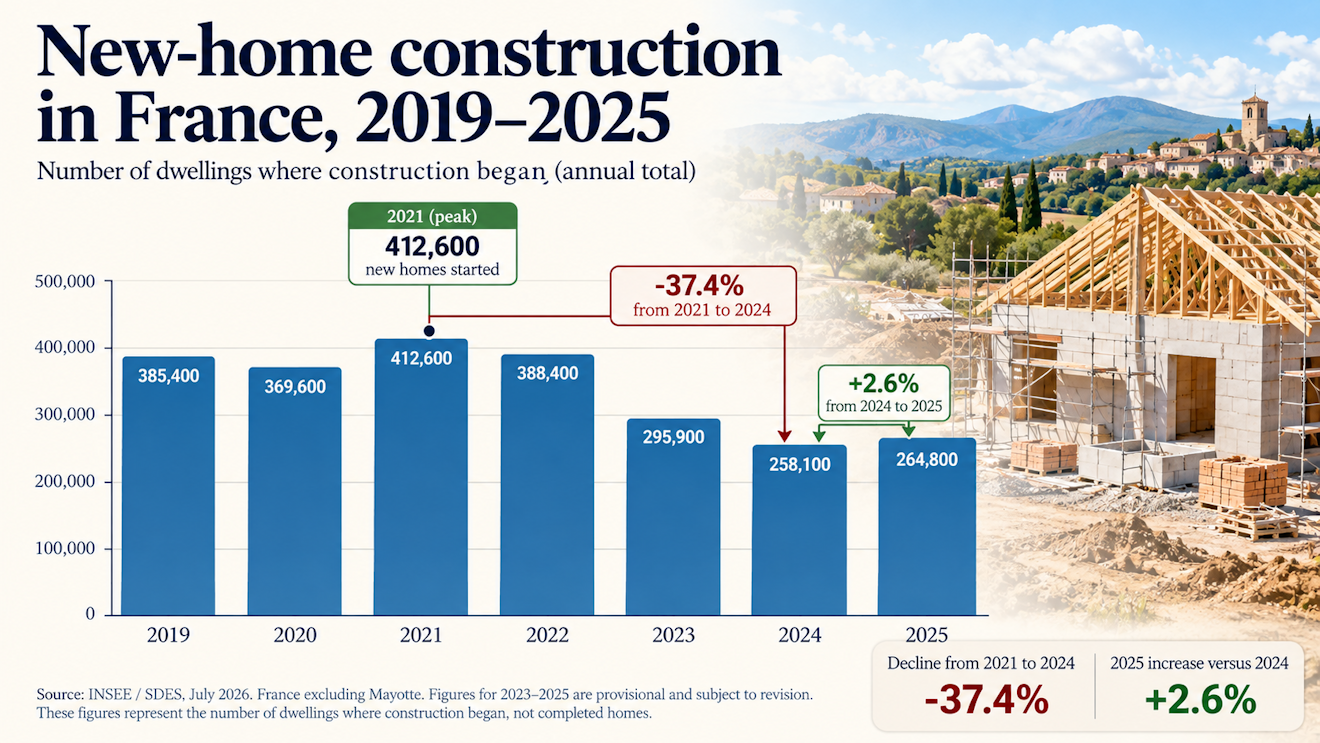
In terms of bew builds, the rise in the price of construction materials, especially since the start of the Ukraine war, has seriously impacted the construction of new-homes in France. Figures from the French statistics body, INSEE, show that new-home construction in France fell by -37%, from a peak of 412,600 homes in 2021 to just 264,800 in 2025.
7. Will the presidential election and high fuel prices affect the French property market in 2027?
France's presidential election in 2027 introduces another element of uncertainty into an already fragile housing market.
There is an old saying that French people do not buy houses during an election. I don't know how much truth there is to this (although I have heard it from more than one person), uncertainty about future government policies, taxation and the wider economy can encourage people to postpone major financial decisions.
The other major concern is the cost of energy. The conflict involving Iran has created uncertainty over international oil supplies, while the continuing war in Ukraine and restrictions affecting Russian energy exports have added further pressure to global living costs. High petrol and diesel prices affect household budgets directly, particularly in rural France where owning a car is often essential. Higher transport and energy costs can also feed through into food prices, construction materials and other everyday expenses.
For the French housing market, this creates another obstacle to affordability. Households spending more on fuel, heating and everyday essentials have less money available for mortgage repayments.
However, we do not believe that political uncertainty or high fuel prices will necessarily bring the market to a complete standstill. People still need to move house, and many have already postponed their plans for several years. The question is whether household finances and confidence will improve sufficiently to allow the market to recover swiftly.
Foreign buyers in France: where are overseas buyers purchasing property?
The one group of buyers I believe could particularly benefit from the French housing market in 2027 is cash buyers, especially foreign buyers.
Without the complications of obtaining a French mortgage, they are often in a much stronger position to negotiate with sellers, particularly when a property has been on the market for some time.
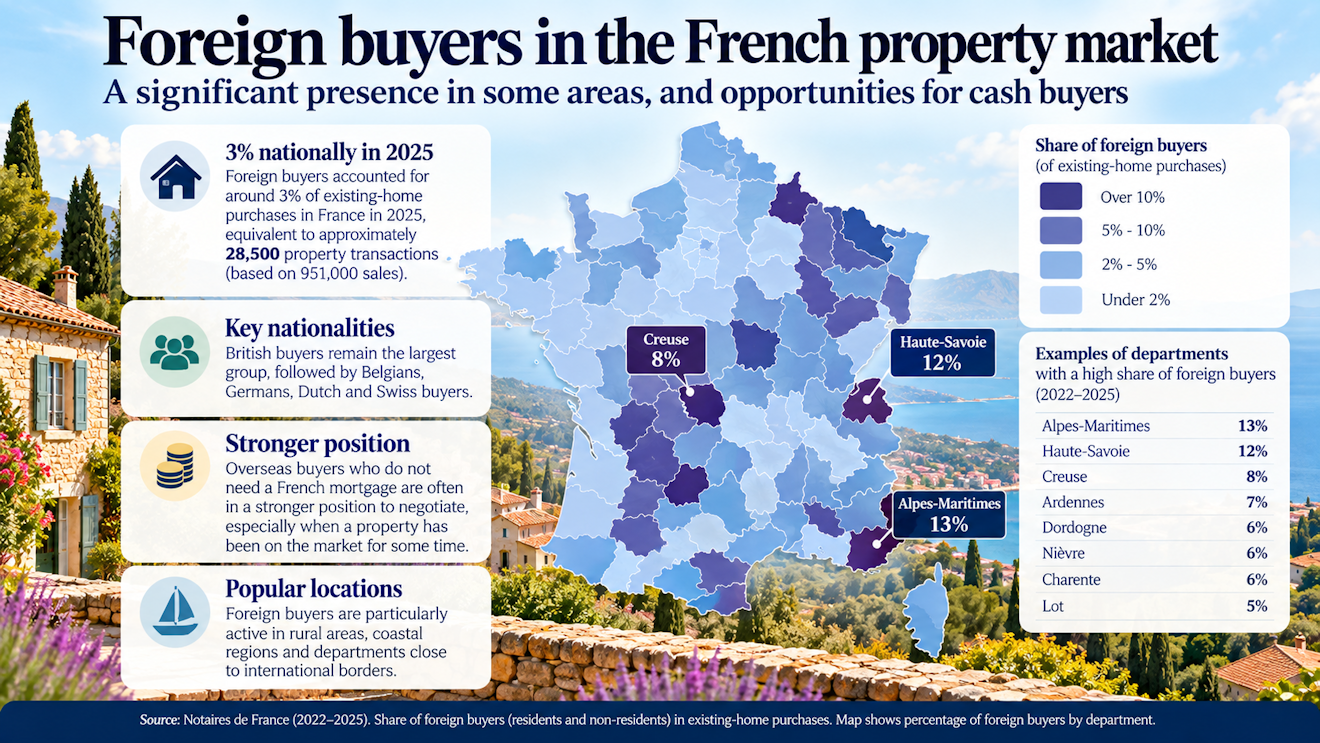
Research published by the Notaires de France highlights the important role foreign purchasers continue to play in the French property market. Although overseas buyers account for a relatively small proportion of national transactions, they represent a much larger share of purchases in certain departments.
How many foreign buyers purchase property in France?
Foreign purchasers accounted for approximately 3% of existing-home purchases in France in 2025. Applied to roughly 951,000 existing-home transactions nationally, that represents an estimated 28,500 purchases. Foreign-buyer activity varies considerably between departments. The Creuse department is an interesting example. Despite its relatively small property market and declining population, it has attracted overseas buyers drawn by affordable houses and the rural French lifestyle.
Alpes-Maritimes and Haute-Savoie also attract substantial foreign interest, reflecting their international connections, closeness to Geneva in Switzerland, attractive locations and established property markets.
Where do British and American buyers purchase property in France?
British buyers have traditionally been one of the largest groups of foreign property purchasers in France, with a particular affection for Southwest France, especially the Dordogne. Meanwhile, American buyers are particularly prominent in the Paris property market. According to the Notaires du Grand Paris, Americans accounted for 19% of purchases by non-resident foreign buyers in Île-de-France in 2025.
Belgian, German, Dutch and Swiss buyers also represent important groups of foreign property purchasers across France.
French property market forecast 2027: is it a good time to buy?
Our prediction for the French property market in 2027 is cautiously optimistic. We expect a gradual increase in house sales as mortgage lending improves and homeowners who have postponed moving begin to accept more realistic asking prices.
However, we do not anticipate another property boom. Our forecast is for broadly stable or modestly rising house prices, with considerable differences between regions. The presidential election throws a bit of a spanner in the works, as does the high energy costs and continuing economic uncertainty. This may slow the recovery, particularly during the first half of 2027.
Is 2027 a good time to buy property in France?
For buyers with secure finances and a long-term plan, we believe 2027 could present some interesting opportunities.
Cash buyers may be particularly well placed to negotiate, while mortgage buyers should concentrate on affordability rather than trying to predict the lowest possible interest rate.
Above all, buyers should look at actual completed property sales in their chosen area, rather than relying on advertised asking prices.
Our conclusion is simple: 2027 could be the year when the French property market finally starts moving again — not because house prices are rising rapidly, but because more people are buying and selling.
Buying property in France: further reading
Planning to buy a house in France in 2027? These six guides cover property prices, mortgages, taxes, the buying process and where to find the best opportunities.
House Prices in France |
French Mortgage Rates |
Property Taxes in France |
Buying a House in France: Checklist |
Best Places to Buy Investment Property |
What & Where to Buy Property in France |





French Mortgage rates in December 2021 were at an historic 50-year low of 1.05%. During 2022, mortage rates in France began to climb to 2.5%, but in 2023 the interest rates on housing loans in France accelerated to 3.63% (Q3 2023) and reached nearly 6.0% for general consumer loans.
The only good news for French homebuyers at the moment, is that mortgage interest rates are forecast to return to below 2.5% during 2025. But the interest rates themselves are not the real problem for French borrowers. The primary issue is actually obtaining a loan in the first place
[SOURCE: Banque de France]
Tightening of French Mortgage market in 2023
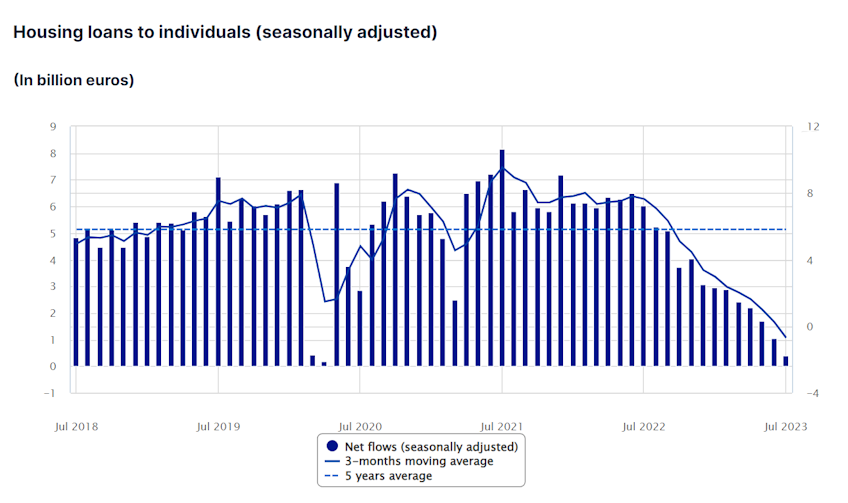 Housing loans in France 2024 [SOURCE: Banque de France]During 2023, the French Mortgage market experienced a severe tightening. The rising interest rates in France were only part of the cause, with many potential borrowers deciding to pause their plans to move house until interest rates have stabilised.
The main damage to the Mortgage market in France was the result of clumsy efforts from the Government and Banque de France to dampen the levels of consumer debt.
During 2022, the Government introduced a new law in France which restricted new mortgage loans to a maximum of 25 years (previously you could obtain a loan over 35 years) and the amount that can be borrowed (including for fees and insurance) was capped at 35% of the borrower’s income.
There were also reports that by the end of Q2 2023, some banks in France had stopped giving out new mortgages, simply because they had reached the upper limit of the amount they could lend during the year (as stipulated by the Banque de France). A lot of house buyers were being told to re-submit loan applications in early 2024.
You can see the impact these regulatory changes had on the Mortgage market in France from this chart produced by the Banque de France. I believe that these regulatory changes will lead to a reduction in the number of house sales in 2024 and it may not be until 2025, that the number of house sales in France will get close to the 1 million mark (where it has been since 2018).
French property Market 2024
Despite all the doom and gloom, it is important not to forget that the housing market in France over the last 5 years has witnessed almost unprecedented levels of growth.
House prices have increased by 27.8% over the last 5 years in mainland France. Property transactions have topped the historically significant 900,000 mark in every year since 2017 and the rolling average of property sales have hit over 1 million in 13 out of the last 20 quarters. So the last 5 years have been a house sellers dream.
In 2024, I think that it is going to be extremely difficult for people looking to sell their house in France. I know this for a fact because I am married to a Real Estate agent and her earnings collapsed by almost 60% during 2023 and 2024 doesn't look to be any better. The main issue for sellers, is that the pool of potential buyers has shrunk rapidly (due to the difficulty in obtaining loans and the high interest rates) and prices have only just started to fall.
A recent report by the Notaires de France, highlighted the issue:
" . . .The housing market, after mostly benefiting sellers, has now turned around. There can be a breakthrough only when sellers agree to lower their price, which, given the rises in recent years, is by no means unacceptable. But there is always a lag between falling demand and sellers agreeing to reduce their prices. 2024 looks like the year of adjustment, when prices fall to match the lower demand . . ."
[SOURCE: French Property Market Report 2023, Notaires.fr]
Collapse in house prices in France? I don't think so.
So basically, I think 2024 will see the French Property Market return to previous trends. After all, it is only in recent years that we have seen such a rapid growth in the total number of house sales and a strong growth in house prices. If you look back over the last 20-30 years, property sales in France averaged around 700,000-800,000 a year. They did not breakthrough the 900,000 barrier until the second quarter of 2017. I think that house prices in France may fall a bit in 2024 (perhaps by 1-2%), but not by as much as people think.
One thing that we noticed even before the slump in house sales, was that there was a very noticeable shortage in the supply of houses for sale (especially in the areas where we operate such as the Herault and Gard departments in Southern France). In 2021 and 2022, there was a very noticeable trend of people moving out from the major cities to the provinces in France. This was a direct result of their experiences during the Covid confinements. This change in buying patterns helped soak up the supply of rural homes and properties in provincial towns (as well as arresting long term declines in population levels in rural areas).
But once people had made the move, they were unlikely to move again so quickly. Plus, with the rapid rise in house prices over the last 5 years, for existing home owners, why would they consider selling their house? Where would they move to? Similarly, land prices for new builds are probably the highest they have ever been and the cost of construction materials are about 20% above what they used to be prior to Covid and the Ukrainian war. So unless you are looking to move away from the region, you may as well stay put in your house. With the prospect of house prices falling slightly in 2024, I think people will be even less likely to move.
The return of the Foreign house-buyers in France in 2027
The one group of people who I think will particularly benefit from the French housing market in 2027, will be cash-purchasers, especially Foreign buyers.
Some recent research by the National Notaires body in France, highlighted a growing trend in the number of foreigners buying houses in France. The report highlighted how:
"Foreign buyers accounted for approximately 3% of existing-home purchases in France in 2025, equivalent to around 28,500 property transactions."
What is interesting is that it isn't the usual popular areas of France leading the way, such as Provence, Dordogne and Britanny. It is the departments of Creuse, Alpes-Maritimes and Ardennes which are proving to be the most popular departments for non-resident foreign buyers. The rural department of Creuse, in Central France, has for many years suffered a declining population. But in 2023, over 8% of property sales within the department were made by non-resident foreign buyers (probably attracted by some of the lowest property prices in France and the beautiful countryside). In Alpes-Maritimes, on the Mediterranean coast bordering Italy, the share of foreign non-resident buyers has reached 7% - a steady trend over the last 5 years. Meanwhile, the share of purchases made by non-resident foreigners in Ardennes has steadily increased, from 2% in 2013 to 7% in 2023.
British buyers have traditionally been one of the largest groups of foreign property purchasers in France, with a particular affection for Southwest France, especially the Dordogne. The region's beautiful countryside, picturesque villages and traditional stone houses have made it a firm favourite for decades. Other popular areas include the Charente and Lot. Meanwhile, American buyers are particularly prominent in the Paris property market. According to the Notaires du Grand Paris, Americans accounted for 19% of purchases by non-resident foreign buyers in Île-de-France in 2025. Belgian, German, Dutch and Swiss buyers also represent important groups of foreign property purchasers across France.
[SOURCE: French Property Market Report 2025, Notaires.fr]
French property Market 2024 - struggling on
So in summary, the economic challenges during 2023, in particular the fight against inflation, have led to a strong decline in house sales and a corresponding fall in house prices. But with interestes rates forcasted to fall during 2024 and into 2025, the French property market should begin to stabilise. The key issue however, will remain the availability of housing loans in France. This will put a break on the French housing market. For cash buyers however, 2024 could be a very good time to purchase a property in France.
Buying property in France: further reading
Planning to buy a house in France in 2027? These six guides cover property prices, mortgages, taxes, the buying process and where to find the best opportunities.
House Prices in France |
French Mortgage Rates |
Property Taxes in France |
Buying a House in France: Checklist |
Best Places to Buy Investment Property |
What & Where to Buy Property in France |