
For a realistic self-build budget, consider the plot, house construction, ground conditions, professional fees, utility connections and a contingency. Official 2024 statistics provide a useful benchmark, but they are not a fixed price list for 2027.
I spoke with award-winning architects François Brunner and Olga Sanina, who have managed new-build and renovation projects across Southern France. Their first-hand advice on controlling budgets remains useful, although the figures quoted in the original interview are historical.
Building costs in France in 2027: what do the official figures show?
According to the French government's 2024 Enquête sur le prix des terrains et du bâti (EPTB), the average construction cost of a new individual house was €1,914 per m² across France, and €1,795 per m² in Occitanie. These are observed 2024 costs, not a prediction or guaranteed quote for 2027.
| House construction benchmark | Average per m² | Illustrative 120 m² house |
|---|---|---|
| France (2024) | €1,914 | €229,680 |
| Occitanie (2024) | €1,795 | €215,400 |
These figures relate to house construction, excluding the purchase of land. Your quote will also depend on the specification, foundations, access to the site, location and exactly what the builder includes.
Source: SDES, EPTB 2024 and Occitanie regional figures.
What architects previously quoted for a house build

In our original interview, Olga divided projects into three broad levels of finish. Her figures below are retained as a record of that conversation; they are not current 2027 estimates.
Olga: This naturally depends on the level of your investment, the complexity and the location of the project. However, let us divide it into three general categories:
- Low budget : 1300€/m2 (standard cheap materials, very simple forms)
- Average budget : 1500€/m2 (many details are chosen to be developed with better materials, the kitchen, the bathroom, the fireplace, the terrace...)
- Good Budget : 1850€/m2 and up (middle/high quality of materials in all the project)
How much does building land cost in France?
François : The other thing that you have to factor into the equation is the price of building land in France. There is a wide variation between regions, and between desirable locations and rural plots. For the right plot you may need to wait several years. Land on a lotissement (small housing estate) may already have water, electricity, drainage and road access, but it can cost more and may be subject to additional design rules. Individual plots can also be found, but local contacts are important.
| Area | Average building-land price | Reference year |
|---|---|---|
| France | €102/m² | 2024 |
| Occitanie | €93/m² | 2024 |
| Provence-Alpes-Côte d'Azur | €204/m² | 2023 |
Sources: SDES EPTB 2024; Occitanie 2024; PACA 2023.
Example budget: building a 120 m² house in France
Using the national 2024 averages, a 120 m² house would have an illustrative construction cost of €229,680. A 600 m² plot priced at €102/m² would cost €61,200. Together that is €290,880 before any additional items not included in those figures. This is a worked example, not a complete turnkey budget or a 2027 quotation.
Other expenses to check before you sign
- Land-purchase costs and notaire's fees
- Geotechnical soil survey, topographical survey and any special foundations
- Architect, engineering and other professional fees
- Water, electricity, wastewater and telecommunications connections
- Site access, earthworks, retaining walls and drainage
- Planning-related taxes, insurance and any separate external works
- Kitchen, flooring, landscaping and other finishes if excluded from the quote
- A contingency for unexpected costs and price changes
Ask each builder for a written list of inclusions and exclusions. Two prices per square metre are only comparable when they cover the same work.
How can you stop a house build going over budget?
Olga: The only way to be sure that your project won't cost you more than expected is to spend the good amount of time on the preparation of the construction on the Etudes phase. As architects, in our office we draw, work and study every detail of the project, exactly in order to avoid the bad surprises on the construction. In my experience, the only reason for Extra-Costs is the lack of "Etudes" before.
François: If you think about it laterally, when you are building a new house you are putting €300,000, €400,000, €500,000 into the ground. So to spend this sort of money and not get a proper geometric study of the ground itself is crazy. The topography and geology of the ground not only determines what you can build, but how you build it. Clients sometimes see paying for a full Geometric study of the soil as wasted money. But it could be the most important €1500-€2000 you will spend on your house. It represents just a fraction of the build costs, yet it will be the one thing which will ensure that the house doesn't move or crack over the first 5-10 years. It could also save you money as well. Without a geometric study, an Architect will be conservative with the depths of the foundations to prevent problems. But maybe the soil condition doesn't require such deep foundations. So my advice to prevent the budget going over at the end of the project, is to spend the necessary money at the start of the project: hire an architect, order a geometric study, pay for builders to properly cost the build (and not just do a quick pro-forma estimate).
2027 clarification: A geotechnical soil survey investigates ground conditions and helps determine suitable foundations. A topographical survey measures the shape and physical features of the plot. They are different studies. The original interview's quoted survey fee is historical; obtain a current local quotation and check whether a soil study is required for your plot.
How did the Ukraine war affect construction costs in France?
François: That is a very good question. Certainly with the squeeze on energy in Europe, we are already seeing the prices of building materials increasing. But perhaps the biggest difference we are seeing is the price of steel. We just didn't realise how dependant the European market was on steel production from Ukraine. Sometimes we have created a specification for a certain type of steel beam, but now we cannot even get accurate costings because the prices of steel are changing daily if not hourly. It can also affect building progress, in terms of waiting for steel products (which are usually integral to the building work).
As an Architect, what this is forcing us to do is to look at alternative products, such as the use of composite beams, composite pre-fabricated panels, etc., which now are becoming more equivalent in price. So yes, unfortunately, this conflict in Ukraine is effecting everything we do.
How best to manage your Builder to control costs
 Paddy Gibbins, Managing Director of Artaxa Real Estate, advises buyers to check that building payments are tied to verifiable stages of work and that sufficient protection remains until completion.
Important: Payment schedules depend on the contract. For a Contrat de Construction de Maison Individuelle (CCMI), French law sets limits on the cumulative payments a builder may request at specified stages. Do not use an informal 10%/20%/30% schedule as a substitute for the legal CCMI rules. Check the contract type, guarantees and payment demands with a qualified French professional before paying.
In the original interview, Paddy explained why he prefers payments to reflect work genuinely completed:
"In reality, the builder takes their profit from each stage of the build, so the final portion that is left is just regarded as 'hassle money'. My advice would be to build in lower staged payments at the start and keep back a larger portion for completion and sign-off. This way you can keep more control over the builder".
Even better would be to include specific "snagging clauses" in the construction contract.
Before appointing a builder, request proof of current assurance décennale (ten-year liability insurance) for the type of work being undertaken. Check the certificate, insurer, dates and insured activities. Depending on the project and contract, you should also establish which other protections and guarantees apply, including assurance dommages-ouvrage and any completion guarantee under a CCMI.
New-home construction in France fell by 36% between 2021 and 2025
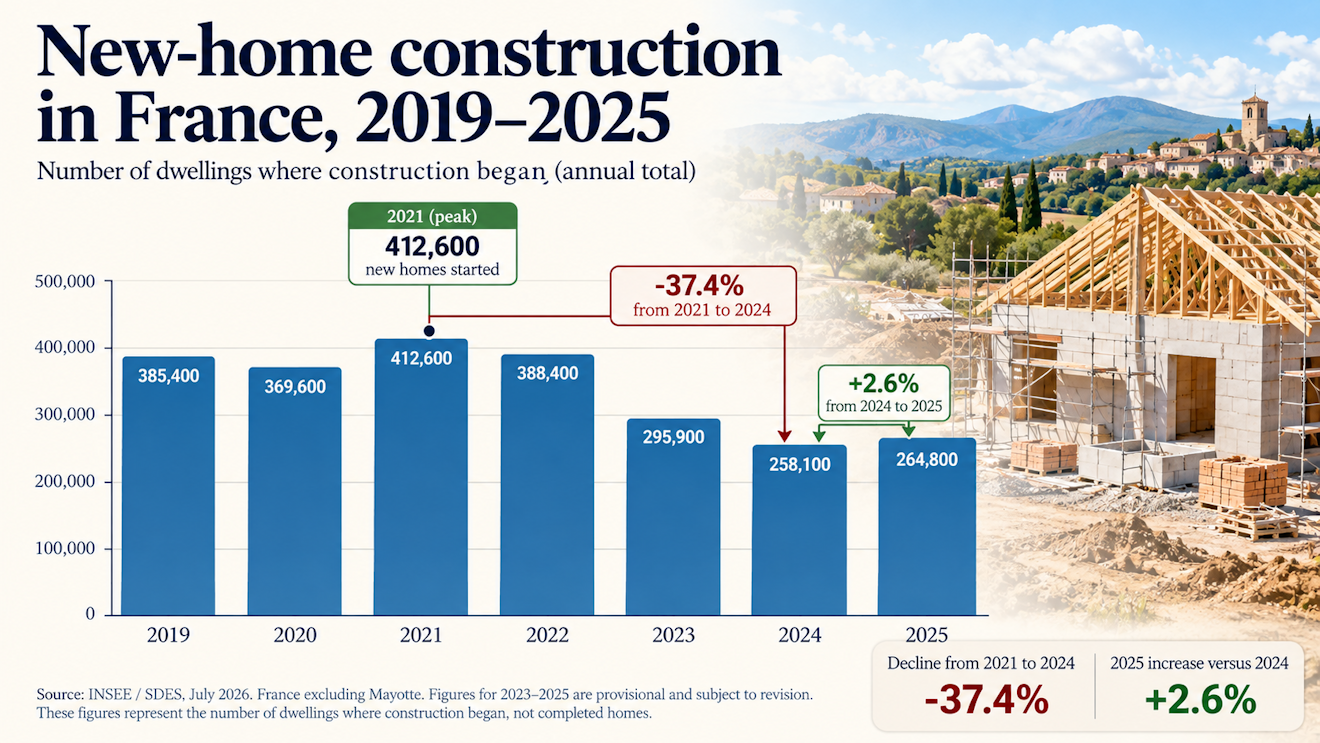
Paddy Gibbins also highlighted the alarming reduction in the number of new-build projects in France over recent years and the underlying causes. The rising cost of building materials, particularly since the start of the war in Ukraine, has contributed to a sharp decline in new-home construction in France. Higher borrowing costs and weaker demand for newly built properties have also affected the construction industry.
According to the figures cited in our construction-market review, work started on 412,600 new homes in France in 2021, compared with just 258,100 in 2024 and 264,800 in 2025. That represents a decline of approximately 36% between 2021 and 2025. These figures concern all new dwellings, not just detached self-build houses.
The figures illustrate the difficult conditions facing French housebuilders and developers. However, for individuals planning to build their own home in France, the important considerations remain the cost of land, availability of reliable builders, planning restrictions and having a realistic construction budget.
Before you start building in France
The most reliable budget is one based on a suitable plot, a properly defined specification, independent professional advice and written quotations that clearly identify exclusions. Compare current local prices with the official national and regional averages, but do not assume the averages represent a finished project at your chosen address.
Further reading: building and buying property in France
Explore our other guides to building and buying property in France, including planning advice, buying off-plan, renovation, mortgage rates and the French property market.
Building a House in France: Advice from an Architect
|
Buying an Off-Plan New Build in France
|
Property Renovation in France: Advice from an Architect
|
Buying a House in France: Checklist
|
French Property Market 2027: House Prices and Forecast
|
French Mortgage Rates in 2027
|