
The French writer, Sylvain Tesson, once observed that:
“France is a paradise inhabited by people who believe they are in hell.”
It is a wonderful observation, and one that captures something about the French national character. France has a long tradition of political protest, public debate and dissatisfaction with its governments. The current concerns about public debt, economic growth and political instability are serious, but the French have been arguing about the direction of their country for generations.
And yet, despite all this, France remains one of the most attractive countries in the world in which to live, work, retire or own a holiday home.
So, is buying an investment property in France in 2027 still a good idea? Where can you find properties at reasonable prices? Which areas offer attractive rental returns and the potential for long-term capital growth?
I believe the answer to many of these questions lies in the South of France. And in this article, I will explain why.
Why I should buy investment property in France
I believe there are four very good reasons why you should consider buying an investment property in France.
Firstly, despite recent fluctuations in house prices and higher mortgage rates, the French property market has shown considerable resilience over the longer term. For buyers who are prepared to research the market carefully, there are still opportunities to purchase properties at attractive prices.
Secondly, although the French economy faces some serious challenges, the country retains considerable underlying strengths. France remains a major European economy, with world-class industries, established infrastructure and one of the world's largest tourism markets.
Thirdly, certain areas of France benefit from two distinct rental markets: summer holiday rentals and longer winter lets. Combining these markets can produce attractive rental yields, particularly in the South of France.
Finally, I believe that demographic trends, continued infrastructure investment and the enduring appeal of the Mediterranean climate will support demand for property in Southern France over the coming decade.
1. Resilient property market in France
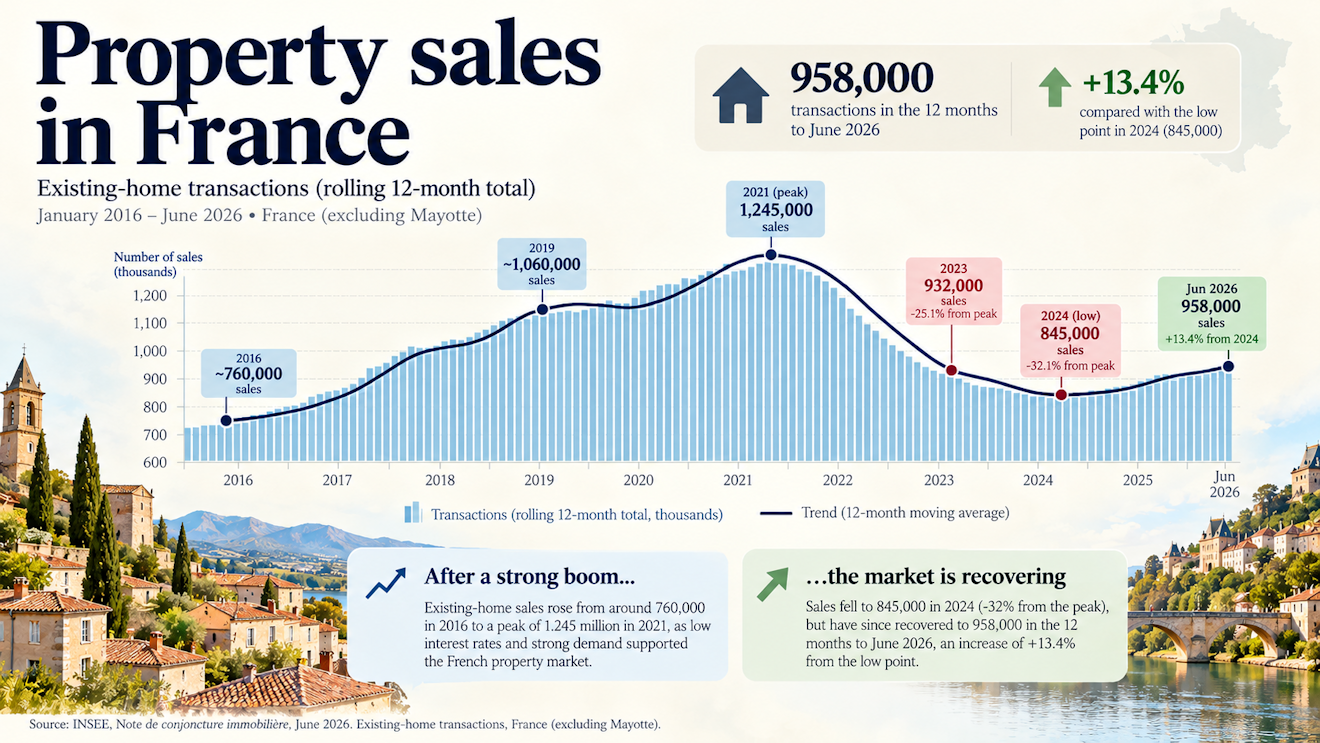
The French property market has experienced considerable changes over the last few years. Following a period of strong house-price growth during 2020–2022, higher mortgage rates and rising living costs have caused the market to slow down in recent years. However, there are now signs of stabilisation, with property transactions recovering and buyers returning to the market.
According to the French statistics body, INSEE and the professional body of French property lawyers, Notaires de France, approximately 958,000 existing-property transactions were recorded during the 12 months to June 2026. House prices remain under pressure in some areas, but buyers now have more time to consider their options and negotiate on asking prices.
Of course, France is not one single property market. Prices and demand vary enormously between Paris, Bordeaux, Provence, the Côte d'Azur and more affordable regions such as the Languedoc. Understanding local market conditions and buying at the right price are essential. A property developer once gave me a great tip once:
"In France you make money when you buy property, not when you sell it."
What he was saying was that you have to get you purchase price correct and not spend too much money on renovations and refurbishment in order to realise a good investment, because France is not a property market where you get year on year 10% growth in house prices.
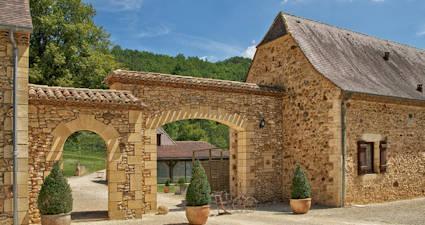
Buying Property in France: Complete Guide for 2027
Buying at the right price is one of the most important parts of a successful property investment. Our practical guide explains the French buying process, purchase costs, legal checks and common mistakes to avoid.
One of the reasons I recommend investing in French property, is that the market is generally less speculative than in some other countries. France has experienced periods of rising and falling house prices, but its housing market has traditionally been less prone to the dramatic boom-and-bust cycles seen elsewhere.
There are several reasons for this. French banks generally take a cautious approach to mortgage lending, with strict affordability checks and limits on how much households can borrow. In addition, almost all new French mortgages are fixed-rate. According to the Banque de France, 99.5% of housing loans were fixed-rate in August 2026, providing borrowers with protection against sudden increases in their monthly repayments.
French property transactions are also subject to an established legal framework, with notaires overseeing the transfer of ownership and estate agents regulated under the Loi Hoguet. Together, these factors help create a more structured property market, where long-term ownership is generally more important than short-term speculation.
Of course, French house prices can still fall, as we have seen in recent years. But for investors looking to hold a property over 10 or 15 years, rather than trying to make a quick profit, I think the relative stability of the French housing market is one of its greatest attractions.
2. France's economy in 2027: reasons for optimism?
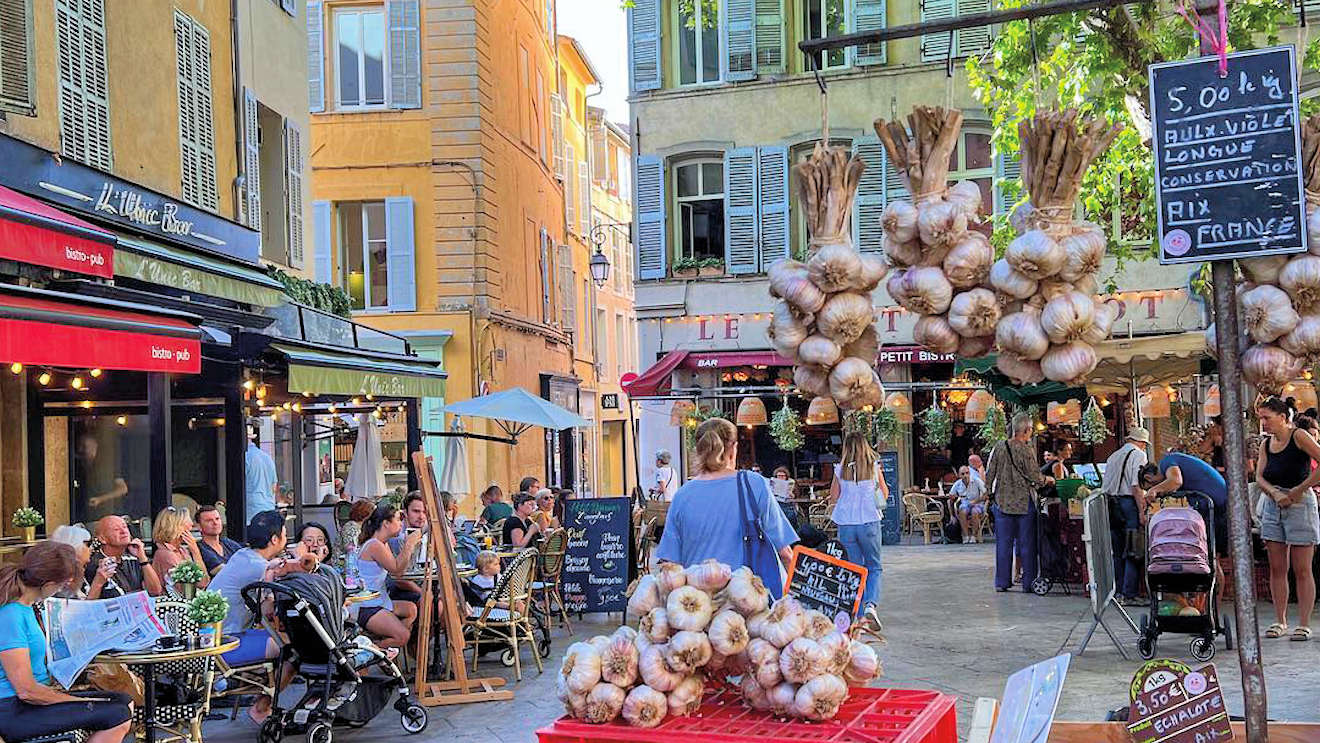
There is no disguising the fact that the French economy is facing some serious challenges. Public debt reached 119% of GDP in the second quarter of 2026, economic growth has been sluggish and political uncertainty has made it difficult for successive governments to get the country's finances under control.
According to the Banque de France, the French economy is forecast to grow by just 0.4% in 2026, followed by 0.9% in 2027 and 1.2% in 2028. These are hardly spectacular figures, but they do suggest a gradual recovery.
So where are the grounds for optimism?
Well, I think it is important to distinguish between the financial problems facing the French government and the underlying strengths of the French economy.
France remains one of Europe's largest industrial economies, with internationally competitive businesses in aerospace, defence, engineering, agriculture, pharmaceuticals and luxury goods. It has an extensive transport network, a highly skilled workforce and important centres of research and technology.
Tourism is another enormous strength. France welcomed approximately 102 million international visitors in 2025, generating a record €77.5 billion in international tourism receipts. Despite all the negative headlines about the French economy, millions of people still want to come here every year.
And this is something you can see in Southern France. Toulouse remains a major centre for the aerospace industry, Montpellier has developed important technology and healthcare sectors, and Marseille continues to benefit from its position as a major Mediterranean port. Investment in transport infrastructure, including improvements to railway connections between regional cities, should also help support their longer-term development.
Having lived in the South of France for many years, I think it is easy to underestimate just how much these regional economies have changed. The growth of Montpellier, the expansion of Toulouse and improvements to transport and communications have made Southern France an increasingly attractive place to live and work, not simply somewhere to spend a summer holiday.
Of course, a stronger economy does not automatically mean rising house prices. And with France's public finances under pressure, investors also need to consider the possibility of changes to property taxation.
But buying an investment property in France is not the same as investing in the French economy as a whole.
What really matters is the property you buy, the price you pay, the location you choose and the rental income that property can generate. A well-located villa in the South of France, attracting summer holidaymakers and longer winter tenants, operates in a very different market from an apartment purchased purely for residential letting in Paris.
And this is where I think certain areas of France, particularly the South of France, continue to offer interesting opportunities for property investors.
3. Property in France: high rental yields

When it comes to property investment, there are a number of factors which contribute to a successful outcome. The first is to buy a French property at 'good value'. Basically, you search for property below market value (a renovation project) or buy property when the house prices are depressed. As we have outlined above, we believe that now is the time to consider buying a house in France.
Secondly, when borrowing costs are reasonable and rental yields are high, the conditions for property investment can be favourable. Although interest rates across the Euro Zone are no longer as low as they were a few years ago, the potential rental yields available in the South of France can still make property investment an attractive proposition, particularly for buyers planning to hold their property over the longer term.
Thirdly, when it comes to rental yields, Property Investors traditionally look at long term residential property rentals to generate return on investment. But in France, residential rentals are problematic. The law heavily favours the tenant and market rates are not that favourable. However, there is an overlooked niche in the market which we believe opens up certain areas of France to property investment.
In coastal areas of France, especially in the South of France, two distinct rental markets can work together. There is demand for longer winter rentals from people house hunting or just looking for some winter sun. On average, the typical rental lease is for 6 months, between the months of October to May. Then there is the highly profitable summer holiday rentals market between June to September.
When these two rental markets are combined, even relatively modest properties can earn between 7% to 9% gross rental yields. Around three quarters of the income will come from weekly rentals in the summer and the remainder from winter rentals.
For example, a 3 bed villa with a private pool, purchased for €350,000, could generate €20,400–€21,600 from 8 weeks of summer bookings and six months of winter rentals. Add four weeks of shoulder-season rentals at €1,500 per week, and the total annual rental income rises to €26,400–€27,600, representing a gross rental yield of approximately 7.5–7.9% before costs and taxes.
Actual returns depend on location, interior design, running costs and the property's purchase price. The key factor in all of this, is Occupancy. Don't get fixated on the rental price, occupancy is King. Our Buy-to-Holiday-Let guide explores this rental model in more detail.
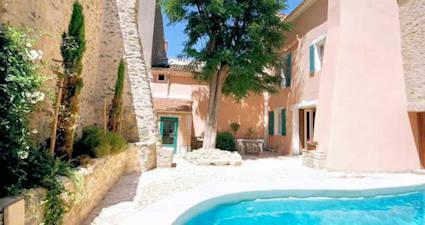
Buy-to-Holiday-Let Property Investment in France
Ever thought of owning a home in the South of France and using it to help fund your retirement? Discover how combining high-income summer holiday rentals with longer winter lets can generate very attractive rental returns. We explain which properties work best and what rental income you could realistically expect.
Explore the Buy-to-Let Guide →The property market in the South of France has generally been more resilient to the steep rises and falls in house prices seen in some other markets. The real boom years were between 1998 and 2008, when French house prices virtually doubled. Since then, the market has experienced periods of growth, stagnation and occasional price falls, rather than the spectacular increases seen during that earlier decade.
It also has to be said that there are two very different property markets in the South of France. The Côte d'Azur and Provence command considerably higher prices, while the Languedoc still offers relatively affordable properties and, in my opinion, some of the best opportunities for generating attractive rental yields.
| Rental weeks | Weekly rates | Total income | |
| Holiday rentals (High season) | 8 | €2,250 | €18,000 |
| Holiday rentals (Mid season) | 4 | €1,500 | €6,000 |
| Winter rentals | 24 | €300 | €7,200 |
| Gross rental income | €31,200 | ||
| Booking commissions | €1,500 | ||
| Property Management costs | €2,300 | ||
| Income after fees & costs | €27,400 |
In the Languedoc, you can still buy a relatively straightforward 4 bed villa with a private pool for around €345,000–€390,000. Nothing particularly luxurious, just a comfortable family villa in a good location, suitable for both summer holiday rentals and longer winter lets.
At these purchase prices, the potential rental income is particularly interesting. As illustrated in the table, a villa generating €31,200 in potential annual rental income, would produce a gross rental yield of approximately 8.0–9.0%, before running costs, mortgage payments and taxation.
Of course, achieving these returns depends on buying the right property, setting realistic rental rates and maintaining good occupancy throughout the year. There will also be costs for maintenance, insurance, utilities, property taxes, cleaning and management. But the opportunity to combine two distinct rental markets is what makes the Languedoc particularly attractive for property investors.
One of the attractions of this type of property investment is that the rental income can help cover the cost of ownership and contribute towards mortgage repayments. Over 15 or 20 years, you could build up a substantial asset in the South of France, mainly funded by other people (holidaymakers and longer-term tenants).
And when you eventually retire, you have a choice. You can sell the villa, move into it permanently, or spend nine months of the year enjoying the South of France and continue renting it out during the profitable summer season (and enjoy a nice 'pension top-up' of €24,000 gross rental income from the 3 months of summer bookings). That doesn't sound too bad to me.
4. South of France: Europe's Retirement home

So we have already outlined why the South of France is an ideal choice for property investment based on high rental yields, but the same could also be said of Paris or Bordeaux. What I think tips the balance in favour of South France as opposed to other parts of France are demographic trends, infrastructure investment and climate. All of these factors are going to combine over the next 10 years to make the South of France the main place to invest in property in France.
Demographic trends
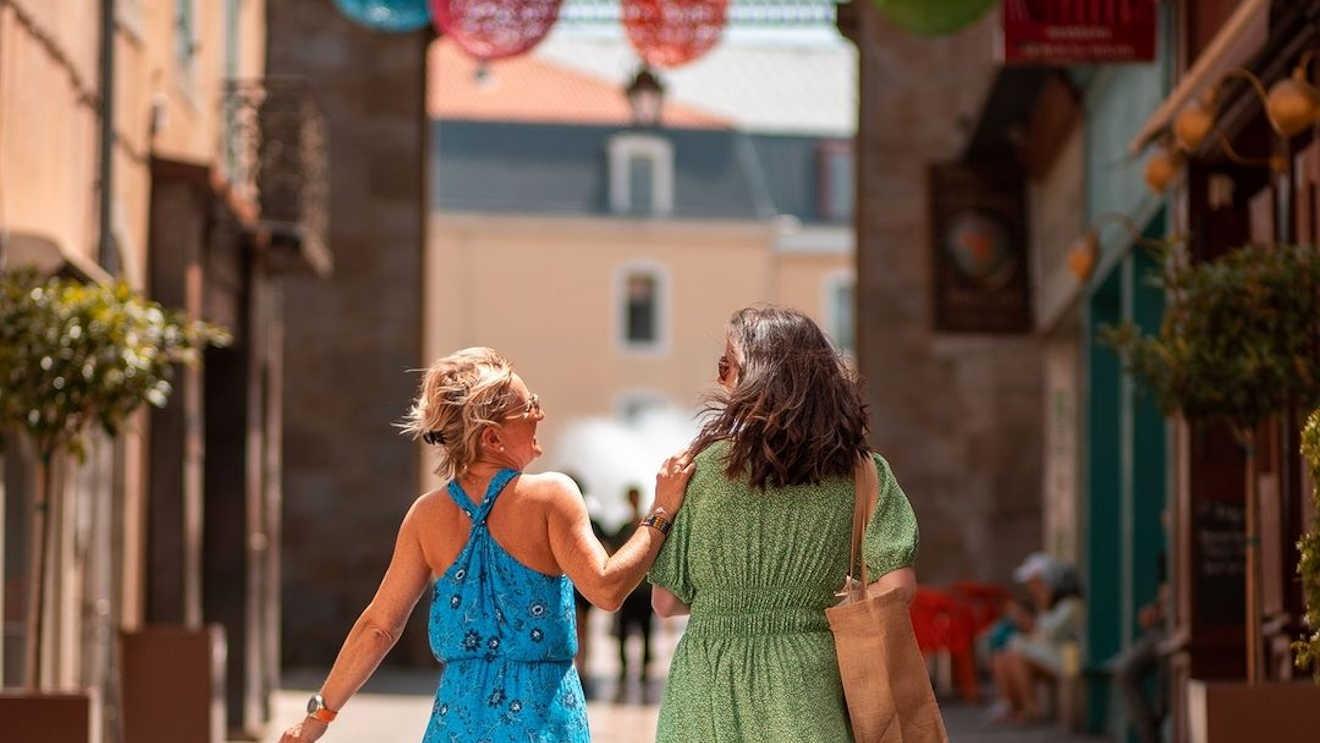
As the population of Northern Europe continues to age, a sizeable minority are predicted to choose the South of France as either a permanent or secondary retirement home. A few years back, every village and commune in the South of France was tasked with producing a plan to increase the housing supply by 20-30%. Why? It was to meet the predicted demand from Northern Europeans moving to the South of France. The economic crisis of 2008 hit this plan a bit, but you only have to look around and you can see more Norwegians, Swedes, Dutch, British, German, Polish and Northern French people buying up houses in the South of France.
As someone who worked extensively in the Middle East from 2008 to 2016, I can also foresee many ex-Pat workers there choosing to relocate to South France. Why? Well when the ex-Pat workers call time on their work contracts in Dubai, Abu Dhabi and Qatar, what will they do? They are unable to stay in those countries without a work contract. Will they choose to return to the rain and wind of Northern England, Ireland or Belgium after working in 30 degree plus weather for 20 years? Will they choose to buy property in Turkey? Possibly, possibly not. Spain? Perhaps. Italy? Not so sure. But France is close enough to home, that you can hop on an EasyJet or Ryanair flight when you need to. The South of France has the climate people are looking for and it retains it's special allure. That is why I think that it will continue to attract people in large numbers. The Cote d' Azur is almost full to bursting and expensive. But the Languedoc remains largely empty and full of houses and land to buy.
Infrastructure development
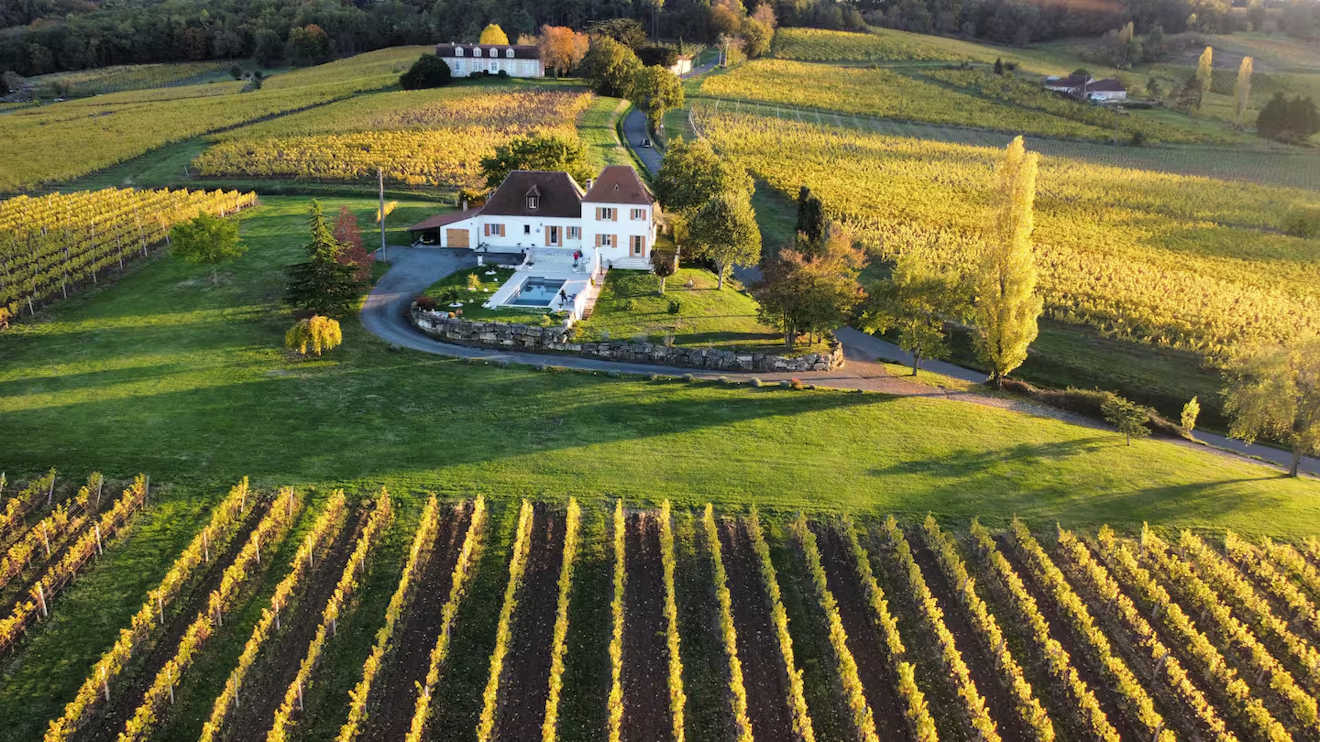
Secondly, the continued investment in France's transport infrastructure, including the new high-speed railway between Bordeaux and Toulouse and the planned improvements between Marseille and Nice, will make the South of France even more accessible. The growth of regional airports, particularly Toulouse, Montpellier, Marseille and Nice, has also made it easier for international buyers and holidaymakers to reach the region.
But there is another form of investment which I think is equally important, although it is often overlooked: protecting the natural landscape of Southern France. It is sometimes said that there are only three things in the South of France: sun, people and wine. Yet the wine industry has faced difficult times, with falling consumption, rising production costs and increasing pressure on smaller vineyards.
What the wine industry also does is help preserve the character of rural France. Nobody wants to see vineyards abandoned or ripped up and replaced with cereal or rapeseed fields. The challenge is to ensure that wine production remains economically viable so that these landscapes can be maintained. Why is this important? Well, what would you rather buy: a nice house in a village surrounded by vineyards or a house in a village surrounded by grain silos and yellow fields? If we can protect the natural landscape, we can protect the value of properties in the South of France.
Climate
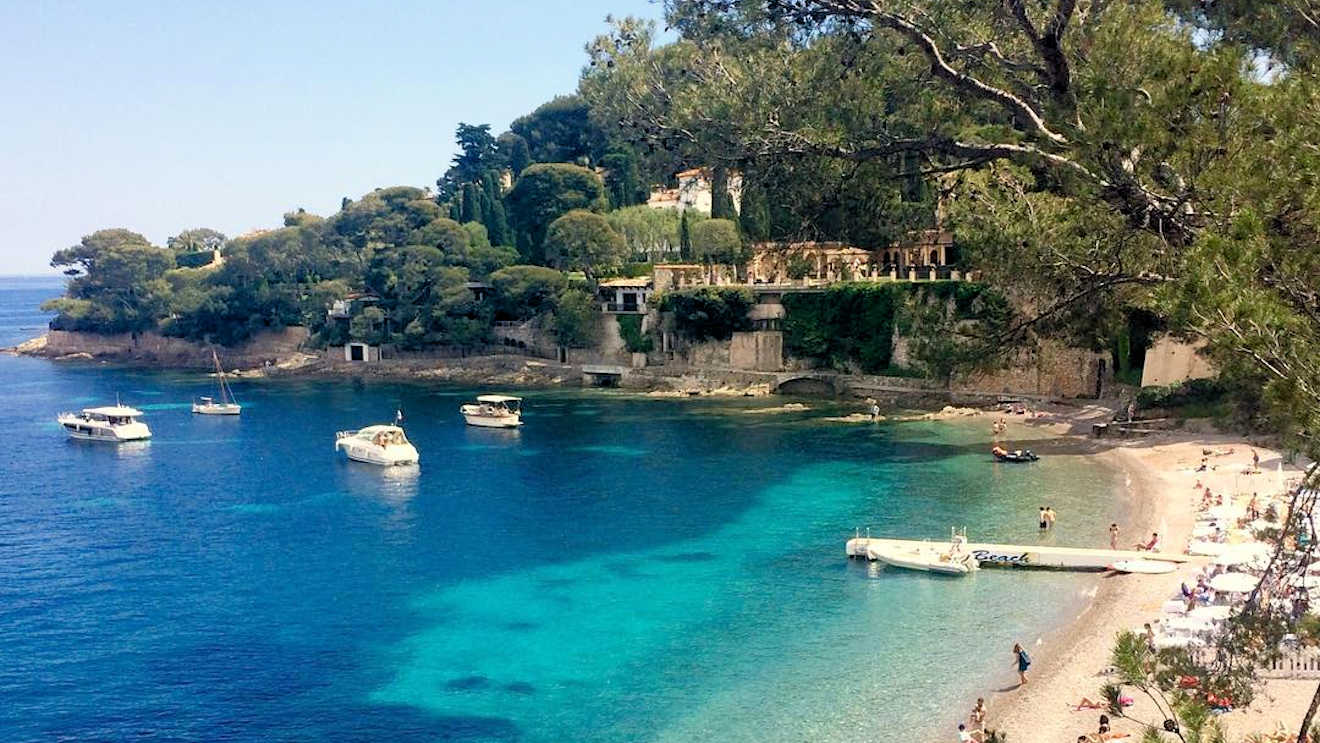
Thirdly, with a climate of over 300 days of sunshine a year, the South of France will not only continue to prosper from it's tourism industry (like it has successfully done so over the last 150 years), but it will also benefit from the investment in renewable energy sources (primarily wind and solar energy). With developments in battery storage technlogy, solar energy and small residential wind turbines will get a second-wind (if you pardon the pun).
There was a risk that with the phasing out of Government tax subsidies, solar panels and wind turbines would move into a slow decline. But with the development of new battery technology which makes it cost effective to store surplus energy to be used on cloudy, windless days; the renewable energy sector will get a much-needed boost. The centre of the French renewable sector is based in the South of France.
In addition, the South of France has seen continued growth in it's key business hubs (Toulouse: aerospace; Montpellier: bio-tech and IT; Marseille: research & development). This will continue to draw more people into the South of the country and continue the upward demand for housing in South France.
Buying Property in France: Complete Guide
Buying a house in France isn't just about financial returns. From beautiful villages and Mediterranean beaches to local markets, great food and a more relaxed pace of life, there are plenty of reasons to own a home here. Discover the lifestyle benefits and what to consider before buying.
Explore Our French Property Buying Guide →
Explore this topic
Planning to invest in French property? These guides look more closely at house prices, regional investment opportunities, the property market and rental taxation.
French House Prices: Trends and Outlook for 2027
Discover how French house prices have changed, the differences between regions and what the latest trends mean for buyers.
Explore French house prices →French Property Market Forecast for 2027
Our analysis of the French property market, including buyer confidence, mortgage rates and the outlook for 2027.
Explore the property market →Best Places to Buy Investment Property in France
Compare regions and discover where property prices, rental demand and long-term investment potential offer opportunities.
Explore investment locations →Renting Out Furnished Property in France
Understand the LMNP furnished-rental tax system and important tax considerations for property investors.
Explore furnished rental taxation →