
If you own a second home in France, you may have wondered whether renting it out would help cover the annual costs. Summer holiday rentals can generate excellent weekly income, while longer-term winter lets can bring in money during months when the house might otherwise stand empty.
We have been involved in French property rentals since 2006, working with both summer holiday rentals and longer-term furnished stays. In that time, I've met owners who expect their house to earn top dollar without spending a penny on it, and others who are so worried about French tax and tenancy laws that they leave the property empty all year.
Neither approach makes much sense. With realistic pricing, good presentation, proper management and professional advice, a French holiday home can contribute substantially towards its running costs. But it does take work. Here is how I would approach it.
1. Why rent out your holiday home in France?
There are four common reasons: earning income, maintaining the property, making better use of it and keeping it occupied while it is on the market for sale.
Money

A well-located, attractive property can generate a worthwhile annual income. Some larger or particularly desirable houses may bring in €25,000–€40,000 gross per year, although that is certainly not a typical or guaranteed return. For many owners, the more modest aim is simply to help the house pay its way.
Depending on its location, a property may benefit from two distinct markets: higher-priced weekly holiday rentals in summer and more affordable monthly rentals during the winter. The important thing is to approach the whole year as a business rather than concentrating on a handful of peak-season weeks.
If this were your business, would you leave the keys with a neighbour, take poor photographs, ignore enquiries for three days and hope the taxman never notices? Probably not. Yet some owners expect excellent returns while putting in virtually no effort.
Good rental income starts with sensible pricing, attractive presentation, a reliable local manager and a clear understanding of the costs involved.
Maintenance and improvements
Rental income can help pay for improvements such as a new heating system, air conditioning, a kitchen refurbishment or even a swimming pool. Rather than funding everything at once, an owner might plan improvements over several years using income generated by the house.
But there is a difference between a property that is charmingly traditional and one that is simply uncomfortable. You might be happy to put up with an ancient mattress or a temperamental boiler for two weeks. Someone paying to stay there should not have to.
I remember visiting a pretty house in Mirepoix. From the outside it looked lovely. Inside was another story. The lounge had four armchairs that looked more like dining chairs; the beds were antique in the sense that nobody taller than five foot two could fit in them; and the kitchen contained a collection of mismatched crockery that appeared to have cost about €3.50. Even a dedicated Spartan would have struggled to stay there for several months.
You can find beautiful furniture at French brocantes and Emmaüs. But furnishing a rental on the cheap is often a false economy. Comfortable beds, decent sofas, reliable appliances and effective heating make a property easier to rent and considerably easier to manage.
Furnish it like a tip and people will treat it like a tip. More importantly, poor presentation usually reduces the rental income you can achieve.
Making better use of an empty property
Many owners discover that they use their French holiday home less than they expected. A house standing empty throughout winter still needs heating, insurance, maintenance and regular checks. Older houses in particular can suffer when they are shut up for long periods.
Having suitable tenants in residence can mean small problems are noticed before they become expensive ones. A damp patch, leaking pipe or failing heater is much easier to deal with when somebody spots it early. Naturally, any arrangement — including house-sitting or occupation at a nominal rent — needs appropriate written terms and legal advice.
Renting while the property is for sale
Selling a house in France can take time, particularly in rural areas. A well-presented, occupied house can sometimes feel warmer and more welcoming to prospective buyers than an empty one. Rental income may also help cover the costs while you wait for a sale.
However, owners need to think carefully about the timing of any tenancy, access for viewings and whether a buyer will expect vacant possession. Do not assume that a property can always be sold and handed over immediately while a tenant is in occupation.
2. Marketing your holiday home in France
The French rental market is competitive. Holidaymakers and longer-stay visitors can compare dozens of properties within minutes. If your house looks tired, the photographs are poor or you take days to answer an enquiry, somebody else will get the booking.
Expectations have also changed. Comfortable beds, reliable fast Wi-Fi, a well-equipped kitchen, effective heating and good outdoor space all matter. In hotter parts of the South of France, air conditioning can be a major advantage. For winter tenants, warmth and running costs may be more important than the swimming pool.
Making your property stand out
Every property needs what I call the “money shot”: the photograph that immediately shows why somebody would want to stay there. It might be the private pool, roof terrace, fabulous view, attractive façade or a beautifully furnished living room.
If you do not have that photograph, consider spending around €300 on a professional photographer. Against the potential income from a successful rental, that can be money very well spent.
Then explain what makes the house special. Is it walking distance to restaurants? Close to the beach? Peaceful and rural? Ideal for working remotely? Don't just list the number of bedrooms and bathrooms. Give people a reason to choose it.
Build up genuine customer reviews
Reviews are king. Previous guests can often sell a property more convincingly than the owner, particularly when they mention the nearby market, wonderful restaurants, comfortable beds or how helpful the local manager was.
Ask genuine guests for feedback and respond professionally to criticism. If something was wrong, explain what you have done to put it right. A few thoughtful, authentic reviews are worth far more than a string of suspiciously glowing ones.
Respond quickly to enquiries
Be quick off the mark. On our holiday rental website, Go Languedoc, we aim to respond to enquiries within two hours wherever possible. A customer who has to wait several days for an answer will often have booked somewhere else.
3. Why professional property management matters
If you live abroad, reliable local property management is not a luxury. It is part of running a successful rental business. The days of asking somebody in the village to leave a key under a flower pot should be long gone.
A good property manager can arrange arrivals and departures, prepare inventories, coordinate cleaning, check the house between bookings and deal with maintenance problems. They should also be reachable when the heating stops working or a water leak appears on a Sunday afternoon.
For longer winter stays, it is especially important to agree who handles repairs, garden and pool maintenance, utility readings and any problems during the tenancy. Make sure these responsibilities are clear before the tenant arrives.
Ask other local owners for recommendations, check exactly what the management fee covers and choose somebody who treats your tenants professionally. Happy tenants, a well-maintained property and fewer emergencies are worth paying for.
4. Tax on rental income in France
One question I hear regularly from British and other overseas owners is: “Do I have to declare my rental income in France even though I live abroad?” Generally, yes. Rental income from French property is normally reportable to the French tax authorities.
That does not automatically make you French tax resident. Nor does it mean the whole of your rental income is simply handed over in tax. The appropriate treatment depends on your circumstances, the type of letting and the applicable tax regime. Furnished rental income may be taxed under micro-BIC or the régime réel, with different rules and potential deductions.
My advice: use a good French accountant, declare the income correctly and focus on running the property successfully. We explain the details in our separate guide.
Tax on Rental Income in France: A Guide for Foreign Property Owners (2027)
Understand how French rental income is taxed, the deductions that may be available and what foreign owners need to declare.
5. French rental laws: choosing the right agreement
French tenancy laws can worry second-home owners. We have all heard stories about tenants refusing to leave and landlords struggling to recover their properties. But not every rental in France is the same.
There is an important difference between somebody renting a property as their permanent home and somebody using furnished accommodation temporarily while spending the winter in France or looking for a property to buy. At Long Term Rentals in France, our advertised properties are intended as temporary landing bases, not as conventional permanent homes.
Where the actual circumstances support a genuine secondary-residence stay, a different contractual framework may be appropriate. The label on a contract is not enough on its own: the purpose and reality of the stay matter. Anyone looking to establish their permanent home in France should generally use a residential letting agency offering principal-residence tenancies.
Owners should obtain proper advice about the rental agreement and their responsibilities before handing over the keys. Our separate legal guide covers this in detail.
French Rental Laws: Advice for Landlords (2027)
Understand the different French rental contracts, principal and secondary residences, and practical ways to reduce the risks of renting out your house.
6. How much rental income can your French property earn?

One of the most important things to remember is that occupancy is king! Owners often become fixated on the weekly or monthly price and forget that the real objective is to maximise the income earned across the year.
Why realistic pricing beats vanity
Suppose we value your house at €1,500 per week during high season. You may think this is an insult. Fred up the road is asking €2,500, so you decide to advertise at €2,000 instead. An extra €500 a week sounds wonderful — but only if somebody actually books it.
- €1,500 × 8 booked weeks = €12,000 gross rental income.
- €2,000 × 4 booked weeks = €8,000 gross rental income.
By chasing the higher weekly rate, you have earned €4,000 less. Of course, actual bookings depend on the market, but the principle is straightforward: a realistic price and a full calendar can beat an ambitious price and an empty house.
Fred may genuinely achieve €2,500 a week. But perhaps his house has a better view, a bigger pool, more privacy or years of excellent customer reviews. Don't just compare your property with more expensive houses; compare it with the cheaper alternatives as well.
I remember valuing an apartment in Marseillan. The owner wanted €1,800 a week in high season. The apartment was lovely inside, but it had no outdoor space and you could just about glimpse the sea if you crooked your neck. The owner was comparing it with a high-end seafront apartment with a balcony and roof terrace. I suggested looking at the other end of the market too. At the time, a comfortable three-bed townhouse with a roof terrace was advertised for around €700 a week. A potential customer could stay there, eat out every evening and still have money left over.
Owners also sometimes calculate what they need the house to earn — mortgage, taxe foncière, gardener, pool maintenance, insurance and every other expense — and then set the rent accordingly. Unfortunately, tenants don't price a property according to your bills. They compare it with the other houses available.
Put sound business economics before vanity. Rental income can make a very useful contribution towards the running costs of your French second home, but it may not cover every expense.
South France rental calculator: our rules of thumb
As a rough rule of thumb, these are some of the fundamentals we use when estimating rental income for properties in the South of France.
These guidelines assume that there is nothing particularly unusual or off-putting about your property. We're talking about a normal, well-maintained house in a typical street, without obvious disadvantages such as neighbouring properties overlooking the garden or pool (vis-à-vis), dated interiors, poor access or an unattractive immediate setting.
Naturally, an exceptional property may command higher rents, while one with significant drawbacks may struggle to achieve these figures. But for a typical rental property, these rules of thumb provide a useful starting point:
- Every 10 km you travel away from the beach, you can lose around €100–€200 per week in high season and €50 per month for longer-term monthly rentals.
- A house with a private pool, four bedrooms and a location within 25 km of the coast can often achieve around eight high-season weeks and another four weeks in June or September, assuming it is properly marketed and priced.
- A private pool can add around €500–€700 per week to the summer rental value.
- A shared pool can add around €200–€300 per week.
- A roof terrace or balcony may improve the property's appeal and occupancy more than its actual weekly rental rate.
- A property with no outdoor space can be much harder to rent, unless it is within walking distance of the beach or in a popular town or village.
- As a guide, the high-season weekly rental price is often similar to what a property might achieve per month in winter. For a house with a swimming pool, we sometimes use around 45% of the summer weekly rate as a starting point for the winter monthly rent. For example, a property achieving €2,500 per week in summer might rent for around €1,200 per month plus utilities in winter.
These are practical benchmarks drawn from experience, not a valuation formula or a promise of bookings. The precise location, condition, privacy, heating costs, competition and quality of the marketing can all move the figures considerably.
Long-term winter rental prices in France
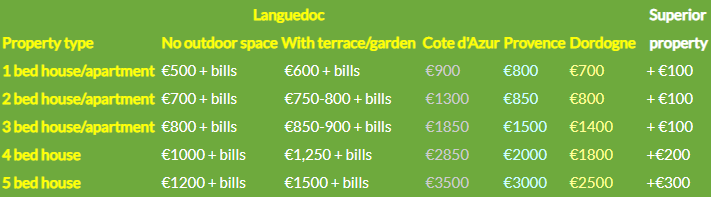
For off-season rentals, typically between October and May, there are broadly two different price markets in Southern France. The Languedoc (Occitanie), Dordogne and former Midi-Pyrénées areas often offer better value for monthly renters than the Côte d'Azur and the most sought-after parts of Provence.
Rental periods extending into the summer, or a full twelve-month booking, generally need to be priced differently because the owner may be giving up the opportunity to earn higher weekly holiday rates. The exact premium depends on the property and the months involved, but around 20% can be a useful initial negotiating benchmark.
Similarly, a house with a private swimming pool can have very different summer and winter earning potential. That seasonal difference is precisely why it makes sense to assess the annual income rather than focus on a single monthly rate.
Rental Calculator: Investment Property in the South of France
Take a closer look at potential rental rates, annual income and the financial considerations when buying or renting out a holiday home in Southern France.
7. Combining summer holiday rentals with winter lets
For many owners, this is where the numbers become interesting. A house might be popular for family holidays in July and August but stand empty from October until Easter. Rather than leave it closed for six months, you may be able to offer it as a furnished temporary landing base for people spending the winter in France, house hunting or exploring a region before buying.
The two markets have different expectations. Summer guests may prioritise the pool, outdoor dining and proximity to the beach. Winter tenants are more likely to ask about heating, reliable internet, a comfortable living room, local shops and the likely cost of utilities.
An example of annual rental income
Let's imagine a house achieves eight summer bookings at €1,500 per week, followed by six winter months at €1,000 per month:
| Rental period | Illustrative gross income |
|---|---|
| Summer: 8 weeks × €1,500 | €12,000 |
| Winter: 6 months × €1,000 | €6,000 |
| Total annual gross rental income | €18,000 |
That is €6,000 more gross income than relying on the summer bookings alone. It is only an illustration: actual income will depend on demand, availability, management fees, cleaning, maintenance, taxes and other costs. You must also use a rental agreement appropriate to the tenant's actual circumstances.
But it demonstrates the point. A winter rental doesn't have to achieve a spectacular monthly rate to make a meaningful difference to the economics of owning a French second home.
8. Is renting out your French holiday home worthwhile?
For many owners, yes. But I would not promise that every house can pay for itself, and I certainly would not recommend setting the rent according to how much you need to cover your mortgage.
Start with a realistic assessment of what the property can earn. Present it properly, price it against comparable homes, invest in comfortable furnishings and make sure somebody reliable is available locally. Get professional advice on tax and rental contracts, then think about the whole year rather than just the summer holidays.
With the right property and a sensible approach, combining summer holiday lets with longer-term winter rentals can help turn a costly second home into an asset that makes a substantial contribution to its own upkeep.
Thinking of renting out your house in France?
If you are considering summer holiday rentals, longer-term winter lets or a combination of both, we would be happy to hear from you. Contact Long Term Rentals in France to discuss whether your property might suit our temporary furnished rental market.
Explore this topic
For more practical advice on owning, marketing and renting out a property in France, take a look at these guides.
Buy-to-Holiday-Let Property Investment in France
Explore the business model of combining high-season holiday rentals with longer off-season stays.
Marketing Your Rental Property in France
Practical ideas for attracting tenants, improving your listing and making your property stand out.
Rental Calculator: Investment Property in South France
Compare potential rental returns and assess the income a French holiday home might generate.
Buying Property in France: Complete Guide for 2027
Our wider guide to buying a French property, understanding the process and planning ahead.
Editorial note: Rental figures and occupancy examples in this article are illustrative rules of thumb, not guaranteed returns or individual valuations. Tax and tenancy arrangements depend on the property's use and the owner's and tenant's circumstances. Obtain appropriate French professional advice before making financial or legal decisions.